
Disclaimer: Some links in this post are affiliate links. If you book through them, we earn a small commission at no extra cost to you. See our Privacy Policy for details.
Is Nazaré, Portugal Worth Visiting Beyond the Big Waves?
When you plan your Portugal trip, one image is almost surely going to show up in your search results and make you go, “OMG!”
Gigantic waves crashing behind a bright red lighthouse.
That is Nazaré for you.
It certainly took my breath away when I was planning our 24-day Portugal trip with my son and husband.
I wanted to see the famous 70–80-foot waves for myself.
But there was one problem: when you plan around something created by Mother Nature, you can’t guarantee it will happen when you arrive.
As a budget traveller, I wondered: Is Nazaré, Portugal worth visiting beyond the big waves?
We visited in November, one of the best seasons for Nazaré’s famous waves, and I decided to spend two days there.
Spoiler alert: I didn’t see the gigantic waves.
So, was spending two days in Nazaré a waste of my time and money?
Definitely not!
After exploring the town, I realised Nazaré is about much more than giant waves.
Its centuries-old fishing culture, unique traditions, beautiful coastline, relaxed vibe and fantastic food surprised me.
If you’re wondering whether you should visit Nazaré even if you don’t see the famous waves, I’m here to show you why it deserves a place on your Portugal itinerary.
Plus, I got some quick tips for making the most of your time there.

Why is Nazaré worth visiting even if you can’t see the big waves?
1. Nazaré’s fishing culture gives it a character you won’t find in a typical beach town
Nazaré’s connection with the sea is much older than its reputation for giant waves.
You notice it in the food, the fish-drying racks and the people you meet around town.
As a seafood lover who was super happy in Portugal with fish and shrimp I was eating, I realised this while eating sardines at Aleluia


They were silvery, slightly oily and had a richer flavour than the sardines I had eaten elsewhere in Portugal.
I ended up asking the restaurant staff why they tasted so different, and he explained how the nutrient-rich waters around the Nazaré Canyon support marine life.
Suddenly, the famous canyon meant something different to me.
I had been thinking of it only as the reason behind Nazaré’s huge waves.
Now I was looking at it from the perspective of the small fish on my plate.
You don’t have to eat seafood to appreciate this side of Nazaré.
My wife Sahana, a vegetarian who enjoys observing and learning local tradition loved Nazare too.

The town’s fishing traditions are still visible in everyday life, including the fish-drying racks along the beach and the people who continue to preserve these traditions.
That connection between the ocean, food and fishing culture is one of the reasons I found Nazaré worth visiting beyond the big waves
2. Nazaré’s traditions make it feel like a living town, not just a tourist destination
The other thing that surprised me about Nazaré was how visible its traditions still are in everyday life.
And none of them depend on the Atlantic producing giant waves.
I first noticed the colourful sete saias, or seven skirts, while walking through the lower town.

Later, in Sítio, we met more women wearing them while selling local snacks.

One woman even explained the tradition to us, which made the clothing feel much more meaningful than something you simply photograph and move on from.


I also found a tiny workshop where an elderly craftsman was making miniature versions of Nazaré’s traditional fishing boats by hand.
I bought one, and it remains one of my favourite souvenirs from Portugal.
These little encounters were part of what made Nazaré feel different to me.
You can come here for the waves, but you can also leave remembering the people, traditions and small details that have nothing to do with surfing.
3. Nazaré has a wilder side beyond its famous beaches
Nazaré may be famous for its giant waves, but the coastline surprised me for another reason.


It has a much wilder side than I expected from a busy Portuguese beach town.
Around Monte São Bartolomeu, you can find forest trails, greenery and campsites.
Praia do Norte feels even more rugged, with thick vegetation along parts of the coast and a very different atmosphere from the main beach.

It was super pleasant to walk along and find smaller caves here.
I remember driving towards Nazare from Lisbon and thinking that I wasn’t approaching a typical beach destination at all.
The landscape felt more like a forest meeting the Atlantic.
So even if the ocean is calm when you visit, there is still a reason to explore beyond the main beach.
Your Nazaré experience doesn’t have to depend on seeing enormous waves crashing against the cliffs.
4. Nazaré has a pilgrimage history that has nothing to do with surfing
If you think Nazaré is mainly a place for surfers and beach lovers, its pilgrimage history might surprise you.


What I liked was seeing this history sitting alongside modern Nazaré.
You have pilgrims, locals, surfers and tourists sharing the same streets and squares.

The town has long been associated with the cult of Our Lady of Nazaré, and the Sanctuary and Chapel of the Memory are still an important part of Sítio.
If you visit in September 2nd week, you can even see the grand festival of ” Romaria de Nossa Senhora da Nazare,” an annual religious pilgrimage and festival honouring Our Lady of Nazareth.

The story of Dom Fuas Roupinho, who was said to have been saved from falling off the cliff while chasing a deer, is woven into the town’s identity.

You don’t have to be religious to appreciate that.
For me, the pilgrimage tradition gave Nazaré a depth that I wouldn’t have expected from a town best known around the world for giant waves.
If you’re interested in history and culture, Nazaré has another layer worth seeing beyond the huge waves.
5. Nazaré still feels like a real Portuguese town despite being famous
One reason I enjoyed Nazaré was that it felt lived-in rather than built entirely for tourists.

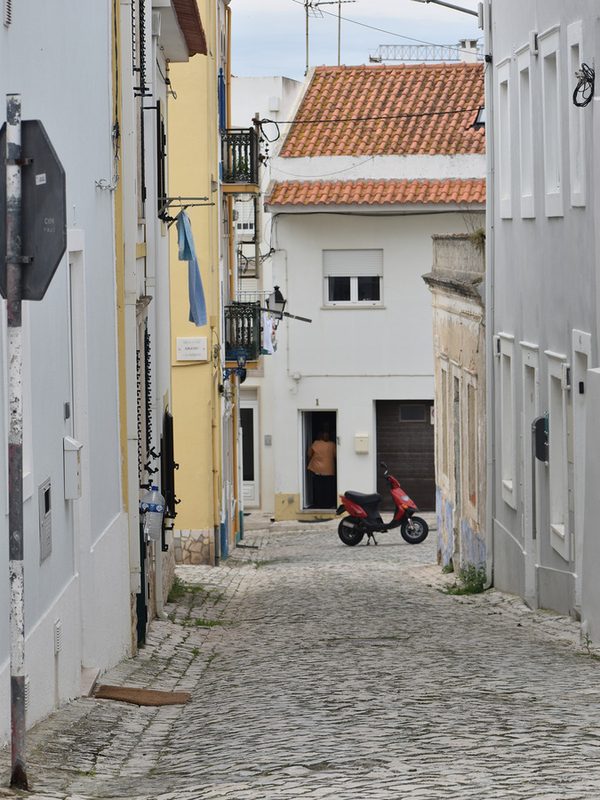
With pastel-coloured houses and colourful balconies on either side of the street, many of the roads seemed to end right at the ocean.


It felt like I was walking through a painting at times.
Even though the lower town and Sítio have plenty of visitors, you still see people going about their everyday lives.
That feels very different from Óbidos, where some parts of the old town can feel almost entirely geared towards tourists.
I also liked how quiet Nazaré became in the evening.

Like most parts of Portugal, restaurants and eateries would shut by 7PM in Nazare too except near beach front promenade.
It was this relaxed, lived-in atmosphere that made me enjoy Nazaré better.
6. Nazaré offers adventure even if you are not a surfer
Nazaré’s reputation may revolve around big-wave surfing, but you don’t need to be a surfer to add a little adventure to your trip.

You can try beginner-friendly surfing lessons. There were kids, learning it when we went!
If you are even more an adrenaline junkie, book a jet-ski experience with an instructor.
I booked a jet-ski experience and then lost my nerve after watching another tourist go out. I still regret cancelling it!

Or explore the surrounding trails by bike or e-bike.
We saw plenty of cyclists riding up and down Lighthouse road actually.

These experiences are not about waiting for a record-breaking wave, although weather and sea conditions still matter.
So if you want more than sightseeing, Nazaré can give you that too.
7. Nazaré is easy to explore by foot
Another reason I liked Nazaré was how easy it was to get around by foot once we arrived.


We drove there, parked at our hotel and didn’t use the car again until we left.
We walked around the lower town and Sítio, stopping whenever something caught our attention.

I even found Nazaré manageable with a stroller, which made a big difference when travelling with our son.
Then of course, funicular since 1889, that connects Sitio to Nazare itself is another reason to visit Nazare.

You don’t need a car for most of the town either. Unless you are heading further out to places such as Alcobaça, you can get around the main areas on foot or use public transport.

For us, leaving the car behind meant fewer transport costs and a much more relaxed experience.
It was another little thing that made me enjoy Nazaré beyond its famous waves.
8. Staying in Nazaré can be good value for a Portuguese coastal town
When you look for accommodation in Nazaré, you’ll find plenty of options, from campsites to hotels and spa stays.
But compared with some of Portugal’s famous coastal towns and bigger cities, many are surprisingly affordable.
We stayed at Hotel Magic in lower Nazaré for two nights.

Our room felt more like a small suite, with an upper loft and a kitchenette, and cost us just €82 a night.
While booking our other stays during the trip, I found that a similar accommodation in Lisbon would have cost around €300 a night, while a similar suite in Porto would have been around €250.
What made Nazaré even more interesting was that we were visiting during the big-wave season, when the town can be particularly busy with wave watchers and surfers.
Even during this busy period, accommodation in Nazaré was still much cheaper than what I found in some of Portugal’s bigger cities.
If you’re planning Portugal on a budget, the affordable accommodation is another reason to consider Nazaré in all seasons – summer or winter’s wave season.
9. Nazaré is easy to fit into a Portugal itinerary
When you’re planning a Portugal trip, Nazaré doesn’t require a major detour or complicated changes, whether you’re travelling by car or public transport.

Whether you have a one-week trip to Portugal or more than three weeks like us, Nazaré is easy to add.
It sits conveniently between Lisbon and Porto: it’s about an hour from Lisbon by car or around 1½ hours by bus, and about 2.5 hours from Porto.
We could also easily combine Nazaré with Óbidos, which is what we did.

Madeira, for example, meant dealing with flights, luggage restrictions and getting around once we arrived.
Piódão, which I really wanted to visit, meant a longer drive into the mountains and a more significant change to our route.
This matters when you have limited time.
You get a coastal destination with a different landscape and plenty to experience, without spending a large part of your trip just getting there.
For us, that ease of getting to Nazaré was a practical reason to visit, even though we weren’t sure we’d see the big waves.
Final thoughts on why I found Nazaré worth visiting though I couldn’t see big waves.
We visited Nazaré in Portugal in November, during the season when the famous giant waves can appear. We didn’t get to see them.
The forecast showed waves of around 13 to 15 feet. Yet I still found Nazaré completely worth visiting.


We walked along the beach at night, something we hardly got to do in other parts of Portugal.
We watched sunsets behind the lighthouse, ate really good food, explored the fishing and pilgrimage cultures, and wandered around without rushing.


For my wife, the image of Our Lady of Nazaré breastfeeding baby Jesus was especially special.
I also loved the little craft workshops, local snacks and even the drive into Nazaré through the forested landscape.
I was the one who had been most excited about seeing the waves, but after experiencing all this, I wasn’t disappointed.
My tip for visiting Nazaré efficiently is to spend at least two days here. A day trip from Lisbon is also possible, but I wouldn’t combine it with Óbidos or Fátima.
There is enough to see and experience in Nazaré, and adding another major stop can leave you rushing through both.


