
Disclaimer: Some links in this post are affiliate links. If you book through them, we earn a small commission at no extra cost to you. See our Privacy Policy for details.
21 Unique Landmarks of Hampi to Explore
In Hampi, deciding which monuments and landmarks to visit can be overwhelming. Hampi is vast spanning over 40 kilometers. So it got too many places people want to visit. While long-term travelers might explore them all, for a shorter stay, it’s wise to plan ahead. This post helps you by listing the must-see monuments and landmarks to make the most of your time in Hampi.
Check out our list of quirky landmarks in Hampi that we absolutely love! After visiting Hampi three times myself and Ashrith five times, we have put together this must-see compilation. You won’t find the temples and sunset spots in this post, as we’ve covered those separately─definitely musts for your itinerary. Instead, we’re highlighting the bazaars, bathhouses, and other unique gems that make Hampi special.
Index
- Bhojana Shale
- Queens Bath
- Mahanavami Dibba
- Stepped Tank
- Underground Chamber
- Lotus Mahal
- Elephant Stable
- Sringarada Hebbagilu
- Talarigatta gate
- Kudure Gombe Mantapa
- Vittala Raya Kola
- King’s balance
- Harakeya Vriksha
- Purandara Dasara Mantapa
- Sasvekaalu and Kadalekalu Ganesha
- Sanapur Lake
- Bukka’s aqueduct
- Soole Bazar AKA Courtesan Street
- Hampi Bazar
- Krishna Sante Street
- Pan Supari Bazar
- Landmarks that aren’t worth visiting Hampi
- Check out our post “Complete Travel Guide to Plan Your Hampi Trip” to learn all the practical information, such as how to get around, where to stay, and when to visit Hampi in detail.
- To discover the coolest sunset points in Hampi, check out our post “Six Best Viewpoints in Hampi to Watch Sunset and Sunrise.”
- Wondering which all temples to visit in Hampi? Check our post “Ten Most Beautiful Temples to Visit in Hampi“
- Want to know where to eat in Hampi? Read our post “Best restaurants and cafes in Hampi“
1. Bhojana Shale
Keen on trying out some Vijayanagara-style dining? Well, that’s not on the menu, but you can check out a cool ancient communal dining spot at Bhojanasala in Hampi.

It’s right by the entrance gate of the Royal Enclosure, surrounded by lush greenery. Picture this: a trench-like structure with stone tops on both sides.Those stone aree carved out with little depressions, just like an Indian Thaali set, forming bowls and plates.
Archaeologists reckon this trench was filled with water before and after the soldiers chowed down so they could give their plates a good rinse. No permanent roof has been found, so they probably just threw up a thatched one with some wooden poles when needed.
2. Queens bath
Want to know how fancy baths of Vijayanagara queens were? Then you must enter the Royal enclosure from the Kamalapur side.

Once you park your vehicles, the first thing you’ll see in the Royal Complex is the Queen’s Bath. Looks plain outside, just a box. But inside, it’s got a veranda with balconies that look like Rajasthan Jharokhas, supported by lotus brackets. There’s still an aqueduct, once used to fill the pond. Windows all around, and cleverly, a water channel around the structure for privacy – May not match Turkish or Iran’s bathhouse grandeur. But indeed, this is way too pretty to be a bathhouse. Back in 2005 & 2014, I could wander in freely inside the Queen’s bathhouse, but now it’s just a peek inside to see the grandeur.
3. Mahanavami Dibba
As you step into the Royal Complex, I notice a tall platform in the distance, standing about 17m high. For a newbie visitors, it doesn’t look too impressive from afar─just another old ruin. But as you get closer to Mahanavami Dibba─a square podium with three levels─the magic unfolds. A ramp next to some big boulders leads you up to get mesmerised! Each level is decked out with stunning relief sculptures.

Although I am not the Queen of Hampi, being on top of Mahanavami Dibba made me feel like royalty, especially because I was there during sunrise. The sight of the sun rising behind Sri Chandra Shekhara Swami temple and lighting up the entire complex area, revealing palace and temple ruins, made me say, “Everything that light touches is our kingdom,” like Mufasa.

What is the history of Mahanavami Dibba?
Hampi’s most famous king, Sri Krishna Devaraya, built Mahanavami Dibba in the early 1510s AD to celebrate his victory over the kings of modern-day Orissa. When he got it built, it wasn’t just a wooden platform but a fancy wooden structure on top, some say made of sandalwood!


Krishna Devaraya would chill there and watch the grand processions during Dasara, Karnataka’s big bash. People who checked out Hampi back in the day swear Hampi Dasara was pure magic. That’s probably why Mahanavami Dibba’s covered in such sweet art. From the top, you can peep the foundations of loads of stone buildings. The archeologists called it the Royal Complex – Because all the big shots and king’s crew, like ministers, stayed here. But sadly, after the Battle of Talikota in the 16th century, most of the palace got wrecked, leaving just the bare bones.
4. Stepped Tank
In my opinion, the two most beautiful places to visit in Hampi are the Vijaya Vittala temple, followed by the Stepped tank “Pushkarini” in the Royal enclosure. This step well of concentric squares doesn’t make you dizzy but brings a charming sense of peace.

Approximately 20+ meters wide, this square tank has steps on all four sides. On each step, there are shorter width steps arranged like pyramids. This place is where beauty meets brains because an extensive stone water channel system ruin still exists on the topmost level of the stepped tank. The water canal system even extends further into the pond, acting like a giant spout. This system was connected to the Tungabhadra river through underground and overhead canal systems!
5. Underground Chamber
When you’re up on Mahanavami Dibba, all you see are the leftovers of Vijayanagara palaces and other princely buildings. But now, you can step into a secret underground chamber in the Royal enclosure and feel like a Vijayanagara king or queen.

Hidden away, this chamber was where all the juicy secrets and treasures were kept. Take the staircase down, soak in the atmosphere, and imagine yourself as the ruler, counting your stash of gold and diamonds.


6. Lotus Mahal
The Zenana Enclosure served as the palace complex for the Vijayanagar Queens. In the midst of the ruins, Lotus Mahal shines as one of the least damaged structures. While exploring Hampi, you’ve likely noticed a consistent Dravidian architectural style. But Lotus Mahal, where the queens used to chill and watch some dancing, has a different vibe─it’s got that Rajasthan and Mughal flair going on. With its cool five-pointed arches and peachy plastering, it’s a hotspot for photos in Hampi.

Is Lotus Mahal just another pretty buildings of Hampi?
The Lotus Mahal in Hampi isn’t just a picturesque spot for endless photos; it’s also a highly adaptable building. It even had its own ancient air conditioning system! With openings in the roof and walls connected to mud pipes carrying water, the palace stayed refreshingly cool inside. Imagine the queens enjoying a chilled-out retreat after their performances in the hot Hampi weather. Strolling around the ground floor and feeling the cool breeze made you feel like royalty, didn’t it? However, since 2017, visitors are prohibited from walking on the floor or entering the building. Simply admire its beauty up close and soak in the atmosphere.
7. Elephant Stable
You’ve seen how queens kicked back and where kings held their hush-hush meetings in underground chambers. Now, let’s check out how the Vijayanagara empire treated their elephants.

The elephant stable, a massive place for those gentle giants, is one of the least damaged spots in the Zenana enclosure. Inside, there are a bunch of chambers where they parked the elephants, some connected with domes on top.
The main chamber is real fancy, with plenty of space. Look up at the ceiling─those patterns, once painted, give off an Iran vibe, without colours. And check out the metal hooks on the walls for tying up the elephants. Oh, and don’t miss the small openings at the back for the mahouts to sneak in.
8. Sringarada Hebbagilu
Throughout your exploration of Hampi’s ruins and palatial complexes, one thing has been missing─the gateway of Hampi. Sringarada Hebbagilu, meaning “Beautiful Gateway,” was once the main entrance to Hampi from the Northern direction.

You gotta wonder what made this gateway so stunning, now it’s just a wreck in Hampi. It used to be surrounded by cattle and sheep when ill maintained. Seeing Sringarada Hebbagilu today hits you right in the feels. Guards there will tell you about its former glory, with fancy lamp stands, sculptures, and a grand wooden door. You might even start doubting if an earthquake did all this damage, but nah─it was the Talikota war that did the deed.
9. Talarigatta gate
If Shrngurada Hebbagilu was a Northern entryway to Hampi, Takarigatta used to be an entry point to the urban center from the riverside. Even today, the asphalt road to Kamalapur passes through this stone archway!


Though heavily damaged, passing through a gateway that once belonged to the Vijayanagara kings is truly fascinating. The coolest part? You can climb up via staircase and catch a glimpse of banana plantations and boulders on either side.
10. Kudure Gombe Mantapa
Out of all the Mantapas in Hampi, Kudure gombe Mantapa totally stole my heart. Those columns with “Jumping Horse” sculptures? Total nostalgia trip to childhood. As you stroll from Gejjala Mantapa to Vijaya Vittala, you’ll spot another this pavilion with columns decorated with horses, sea lions, and flowers. No shrine or idols here, so it was probably just a chill spot for travellers heading to Vijaya Vittala temple.

Today, it’s still one of the coolest places to visit in Hampi, kicking back in these ancient stone digs. Imagine the folks back then sipping water and Ragi Ganji; we’re just here sipping juice or munching on fruits under Kudure gombe Mantapa’s reddish stones, reminiscing about our rocking horse days.

11. Vittala Raya Kola
I always knew ancient Hampi was a well-planned city, but it really hit home when I visited Vijaya Vittala Kola. The location of this water tank is incredibly thoughtful, considering the needs of visitors to Vijaya Vittala. People would come from faraway places to visit the deity here, so after a long walk, they could rest at Kudure Gombe Mantapa.

Once refreshed, they could take a dip in Vijaya Vittala Kola. Then, if they needed to, they could do some shopping at Vittala Santhe next to the Kola. Finally, they could seek blessings at Vijaya Vittala or even observe rituals at the King’s Balance.

Even in winter when we visited, the Kola had no water, but it was still a surreal sight. You can sit on the steps and peacefully admire the tower of Vijaya Vittala Temple from here.
12. King’s balance
Passing by Vijaya Vittala Temple, you’ll spot several stunning stone temples. But a particular ruin that truly embodies the “Glory of Bygone Era” in Hampi is a 5-meter tall stand. In Hindu tradition, there’s a ritual called “Tula Bhara,” where blessings are sought for a specific purpose, especially for children. A child sits on one plate of a balance, while on the other plate, precious items like crops (paddy, wheat, fruits) or spices (pepper, cardamom) are weighed to equal the child’s weight. In ancient times, kings would perform “Tula Bhara” for themselves on special occasions. The stand you see here, known as the “King’s Balance,” was used by the mighty Vijayanagara kings. The king would weigh himself with gold, gems, silver, and precious stones, then offer them to the priests.

If you look closely, you’ll notice three loops on top of the balance where it was hung. Additionally, one of the pillars features a carving of the king alongside his consorts.
13. Harakeya Vriksha
India has countless traditional rituals, and at Harake Vriskha, just after the King’s Balance, you’ll find a unique one tied to the Banyan tree. Local farmers swing by before planting seeds to pray for a bumper crop. They wrap stones in cloth, hang them on the branches, and offer their prayers. Months later, when their prayers bear fruit with a good harvest, they return to remove the cloth, rearrange the stones, and do a little tree puja. So, the branches are decked with clothes filled with stones, surrounded by flat stones stacked like a mini tower.


Unfortunately, despite warnings, a few folks have started using plastic bags, creating a bit of a snag. The official Guards can’t remove them due to religious beliefs once they’re hung!
14. Purandara Dasara Mantapa
One of the loveliest spots in all of Hampi to soak your feet in the river is at the “Purandara Dasara Mantapa”This little pavilion is a nod to the legendary poet Sri Purandara Dasa, who has composed thousands of devotional songs that are huge thing in Carnatic Music. He lived in Hampi and it’s said he penned most of his hits right in this spot! If you’re from Karnataka, chances are you grew up listening to his Geethas, so this place holds major nostalgia points for Carnatic music lovers like us. Even if you’re not, it’s just a sweet spot to watch birds, dip your toes, and chill out.

The Mantapa isn’t visited by every hiker or pilgrim on the move. So you can actually hear the gentle sound of the river flowing in silence. Usually, those who come are admirers of Sri Purandara Dasa. And they often sing a few tunes from the poet’s collection. If you’re lucky, you might catch some local talent jamming out.
15. Sasvekaalu and Kadalekalu Ganesha
As you stroll from Krishna Temple to Hemakuta Hills, you’ll find a Mantapa housing a huge 8-foot-tall Ganesha, known as Saasvekalu Ganesha, named after mustard seeds. Legend has it that Ganesha, being a big foodie, once ate so much he tied a passing snake around his belly to avoid bursting. The statue depicts this, with his belly resembling bloated mustard seeds.

Now that you know the story of our elephant god, let me show you another temple dedicated to him. There’s a 44.5-meter-tall statue carved from a single stone sitting in a similar Mantapa as Sasivekalu Ganesha. But here, his belly resembles “Kadalekalu” AKA Bengalgram.
16. Sanapur Lake
Sanapur Lake is a favorite spot for hippies, backpackers, and long-term travelers in Hampi. Originally created for irrigation, it’s surrounded by boulder hills, creating a snug atmosphere. Famous for its coracle rides, it’s lively in the mornings and peaceful in the evenings. Though you won’t catch a sunset here due to the boulder mountains blocking the view, the lush green paddy fields on one side and the water on the other make for a delightful sight.
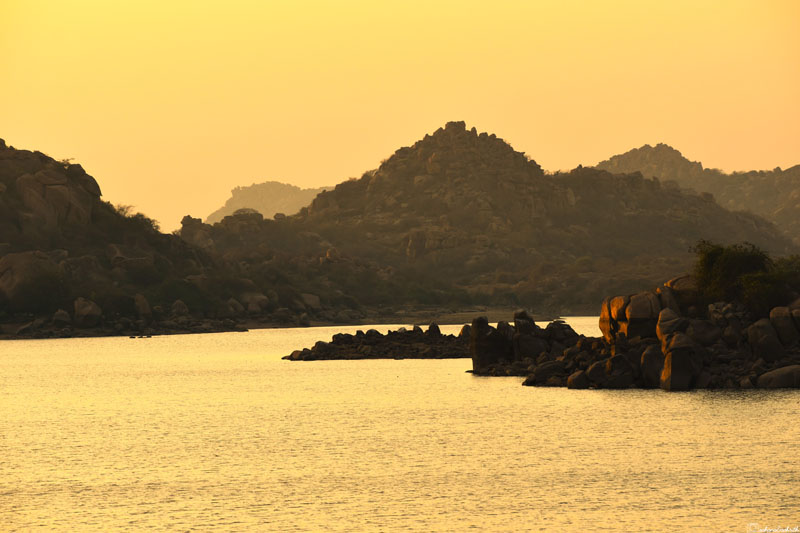
The route to Sanapur itself is interesting. As just as scenic, with lush paddy fields lining the road, dotted with tiny villages packed with huts and cottages. It’s a colorful mix of laid-back hippies in their free spirited clothing and locals in traditional attire.
You’ll even spot foreigners sitting in crowded and dusty bus stands, lost in their books! Witnessing the blend of rural life and the hippie scene is a unique experience at Sanapur. And here’s the kicker: amidst conversations in Kannada or Telugu, you’ll catch Hebrew signs here and there! In the evening, head to the lake bund for relaxed vibes. Watch local Banjara women wrapping up work while hippies zip around on scooters, heading to nearby hut cafes for gatherings.

17. Bukka’s aqueduct
As you drive from Hampi to Sanapur on a Luna in the evening, you’ll pass by lush green paddy fields and boulders. Near Virupapura Gaddi, you’ll spot a peculiar sight: a stout stone bridge in the middle of nowhere, split into two with no clear start or end.

As you approach, you’ll notice it has an upper duct! This is an ancient aqueduct from the 15th century, reminiscent of Roman aqueducts, designed to lift water from lower levels and transport it to the city. Despite its broken state, it stands as a strangely beautiful relic, blending into the natural boulders around it.
Enchanting Bazars to visit in Hampi
When you think of Hampi, you’ll likely hear about the Vijayanagara kingdom’s incredible wealth, with stories of pearls and diamonds sold in heaps at the “bazars.”But did they really weigh and sell diamonds in heaps like grains? Well, that isn’t certain. But visitors to ancient Hampi noted how even regular folks rocked plenty of bling. These bazaars, once landmarks of ancient Hampi, were like India’s original retail spots─more like supermarkets with specific goods near the temples. Visiting them helps you understand what the capital city of Vijayanagar was like. They’re free to visit, but if there’s excavation or restoration work, entry may be restricted.
18. Soole Bazar AKA Courtesan Street
Soole Bazar, the prettiest of all ancient Hampi bazaars, starts from Shri Achyuta Raya Swamy Temple. Historians suggest it was once frequented by courtesans and dancing girls enticing men. Its charm lies in the setting, surrounded by the boulder hill “Matanga” and the ruined yet beautiful Gopuram of Achyutaraya temple. The 50-meter-wide street boasts corbelled stone pavilions, podiums, and a water tank.

I could almost hear the sounds of dancers’ anklet bells, the hooves of traders’ horses, and the giggles of girls echoing here. That’s what makes it one of the most fascinating places to visit in Hampi. This makes it one of the most fascinating landmarks of Hampi you must visit.
19 . Hampi Bazar
The nearly 1km-long bazaar starts just after the Virupaksha temple and ends at the big bull “Nandi.” It’s a perfect spot to imagine the grandeur of the past, with a bustling market selling everything from precious gems to rice, especially in the evenings. Some of these pavilions even served as resting places for those visiting Virupaksha.

I vividly remember in 2005 seeing locals built brick walls between the columns of these ancient pavilions to convert them into houses! It was quite odd to see bright cyan-painted brick walls squeezed between ancient pillars. But by 2011, these walls were demolished, and the inhabitants were relocated
20. Krishna Sante Street
Excavation work in Hampi seems never-ending, given its vastness. Among the latest discoveries is Krishna Bazar, or Krishna Snana Street, located opposite the Krishna temple. It served as the chariot route for the deity’s annual procession. Unlike typical Indian temple car streets, Krishna Bazar sits at a lower level and was likely a market for fruits and vegetables. Cross the main road opposite the Krishna Swamy Temple to find rows of pavilions and remnants of a sacred tank, surrounded by hills, boulders, and banana fields, giving it a mysterious ambiance. This scene oddly reminded me of ancient stadiums in Greece.
21. Pan Supari Bazar
If you’ve visited Banaras as a non-Indian traveler, chances are you’ve tried the famous “Banarasi Pan,” a betel leaf with toppings and sweet fillings. Pan Supari Bazar, meaning “Beetle leaf and areca nut bazar.” Located in front of the famous Hazara Rama temple, Pan Supari Bazar differs from typical Vijayanagar bazaars. Instead of single or double-storey pavilions, it features a giant tree, ruins of smaller shrines, a few pavilions, and a lonely column surrounding a courtyard.


Unlike linear layouts, this bazaar forms a rectangle. I was super excited to be here, thinking Pan Supari Bazar might be where ancient Vijayanagar folks sold our family’s crop from Chikmagalur. I pictured a bustling market with heaps of areca nuts and buyers. But reading the nearby information panel, I learned no one knows why it’s named that. It likely served as a shopping hub for Vijayanagara kings, given its proximity to palace remains.
Landmarks that aren’t worth visiting Hampi
- Mohammadan Watch tower : Just an Islamic style almost destroyed watch tower with only foundations and parts of palaces around.
- Bhima’s Gateway: I expected it to be as mighty as the Mahabharata legend Bhima, after whom it’s named. But it’s just a triangular archway ruin.
- Sister Stone: Often on bloggers’ must-visit lists for Hampi, it’s just two gigantic boulders leaning on each other, creating a passage between them.
- Sugriva Caves: Legend has it that Sugriva from the Ramayana lived here, but the cramped cave doesn’t offer much to see.
- Domed Gateway of Hampi: While its architectural style is unique with a dome, compared to other gateways in Hampi, it may not be worth the journey to see it.
- Pampa Sarovar: Despite its religious significance, it lacks architectural detail compared to other Puskarinis of Hampi and isn’t as scenic as Sanapur Lake.
Which of these Monuments and landmarks would you add to your Hampi itinerary? Let us know in the comment section below.


