
Disclaimer: Some links in this post are affiliate links. If you book through them, we earn a small commission at no extra cost to you. See our Privacy Policy for details.
Best 10 Things to Do in Dürnstein on Any Budget Trip
Curious about the best things to do in Dürnstein but unsure if it’s worth your time? I get it—I wondered the same while planning my two-week Austria adventure in summer 2022.
But now I know why Dürnstein deserves all the hype and fanfare it gets!
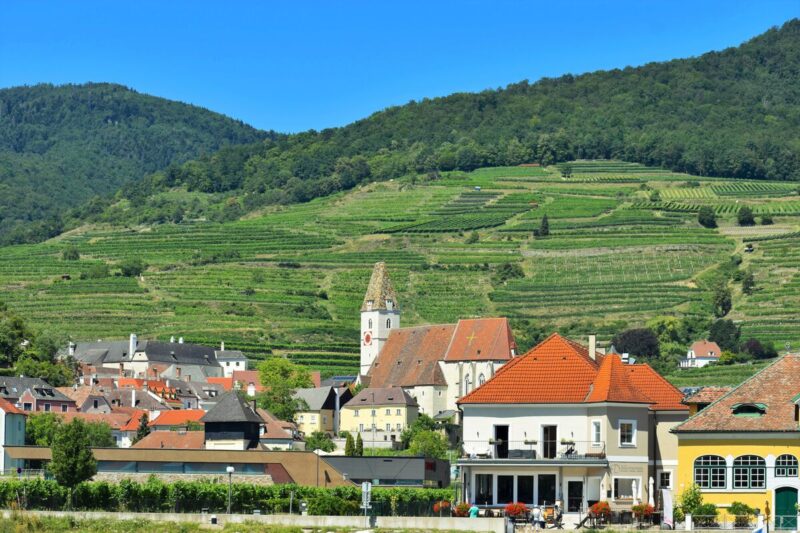
On a Danube cruise during my Wachau Valley stay, I glimpsed Dürnstein’s stone houses and iconic blue abbey tower rising above vineyards and castle ruins—and instantly knew this medieval gem was worth exploring.
Even my mom, who’d never understood my love for old towns, declared, “I wouldn’t mind living in a medieval town if it’s Dürnstein!”
We spent half a day wandering its cobbled streets, picturesque courtyards, and stunning viewpoints—and fell in love all over again.
This guide covers my favourite things to do in Dürnstein, from hidden medieval alleys to riverside swims. Plus tips for planning your own visit from 4 to 5 hours or even a day or two!

Top things to do in Dürnstein
All the places to see in Dürnstein and the best things to do listed here are easy to reach on foot once you’re here.
You’ll likely cover around 3–4 km of walking, with gentle uphill sections but nothing too steep. It’s perfectly doable even for older travellers—I explored it all at a slow pace with my mum over about four hours, and she managed it just fine.
From browsing local shops to relaxing by the river, the top places to see in Dürnstein are all listed below. And if you’re curious how to get here, I’ve included practical travel tips at the end!
1. Visit the Dürnstein Abbey

If there’s one sight that defines the Wachau Valley, it’s the bright blue-and-white tower of Dürnstein Abbey rising over the river and vineyards. It’s definitely one of the best things to do in Dürnstein, especially on a budget.
I made it there just before closing and only had about ten minutes—but I’m so glad I rushed in. The sunny courtyard felt peaceful, and there’s a clever mirror so you can admire the towering spire without straining your neck.

The abbey’s story goes way back to 1372, when it started as a small chapel funded by a local noblewoman. Over time, it grew into a monastery run by Augustinian canons, and in the early 1700s, it got its beautiful Baroque facelift.

Today, it’s still an active church. I loved wandering the medieval cloisters and climbing partway up the tower for stunning Danube views.
Unlike Melk Abbey’s grand halls, Dürnstein stift feels cozy, personal, and at around €9, it’s a beautiful stop that won’t break the bank.
2. Stroll through Dürnstein’s charming medieval streets
If someone tells you Dürnstein’s a medieval town dating back to 1019, and you wonder what makes it so magical—that answer’s hiding in its side lanes.

My mum has always loved old towns, but never fully got why medieval places feel so special. Wandering these quiet streets finally made it click.
She looked around and said, “Okay, I don’t mind settling in Dürnstein—the stone houses, cosy gardens, vineyards, and those tiny lanes…it’s quiet yet so convenient.” And honestly, I felt the same
In Trunergassl, a narrow path runs from the river up toward a quiet courtyard, winding beneath old stone arches and dappled tree shadows.

Hauptstrasse is the heart of Dürnstein’s medieval charm, lined with pastel houses whose conical roofs and timber details look like something from a storybook.

Then there’s Grubelgasse, where medieval stone walls hide cosy cafés with wooden signs and flower boxes spilling over windowsills, and the smell of coffee and fresh pastries drifts through cool archways.

3. Enter through Krems Gate
Whether you come by car, bus, or the pretty Wachau-Bahn train, every road into Dürnstein winds past vineyards, where two towers pop up on the horizon—the bright blue abbey spire and the old stone bastion peeking above the rooftops.

Soon enough, you’re standing in front of the legendary Krems Gate– a must visit place in Dürnstein for all.
At first glance, it looks pretty simple—a stone archway under a sturdy medieval tower. But there’s something magical about it. This eastern gate has been here since the 15th century, once guarding the town as part of Dürnstein’s old defences.

I love how the walls still show faded plaster, tiny windows, and old battlements hinting at centuries of stories. Passing under the arch felt like stepping into another century. Suddenly, narrow streets opened into cosy courtyards framed by pastel houses and winding cobblestone lanes.
4. Shop for Wachau special Souvenirs in Dürnstein
One perk—or tweak—I add to my budget travelling is buying useful souvenirs. For me, that means things I can either eat or use, that fit my budget, and are definitely local.
And my mom, who’s basically the head of our shopping department whenever we travel, absolutely adored Dürnstein’s local goodies. Here’s what you shouldn’t miss:
Apricot goodies
If you’re an apricot lover, Dürnstein is basically heaven.
Wieser Wachau Café & Shop isn’t just any store—it’s tucked into a beautiful whitewashed building with wooden shutters and flower boxes, and feels like wandering into someone’s cosy old home.


Inside, shelves are overflowing with apricot jams (€4–€6), schnapps (€6–€10), gummies, and even apricot vinegar and mustard. I definitely went overboard shopping here—and honestly, no regrets.
I even ended up buying more of their apricot goodies later in Salzburg at their Linzergasse outlet! Their apricot cosmetics smelled amazing, though I’ll admit they didn’t exactly work miracles for my skin.

Wachau wines
The region’s famous white wines—Grüner Veltliner and Riesling—are everywhere in Dürnstein.

One of my favourite stops was Vinotake im Törwächterhaus, tucked inside a medieval stone building near Krems Gate. With its stone walls and old barrels, it’s a gorgeous little shop where you can taste wines from local producers, starting around €20 a bottle.
Even though Domäne Wachau is still my top favourite, it was fun exploring other Wachau wines here.
Saffron surprises
Right by the Dürnstein train station, I stumbled across Wachauer Safranmanufaktur. I never expected saffron to grow in Austria!
The shop is in a charming building, and they’ve even got a small café with stunning views over the valley.
Products range from saffron chocolate (€6–€8) to tiny jars of saffron threads, though prices climb higher for premium quality. I didn’t buy any because it was pricey, but it’s a unique find if you’re curious.
Local honey
While waiting for my bus back to Melk -the Danube town shining under its magnificent abbey, I popped into the Nah&Frisch supermarket near the parking lot and found some local honey (€4–€7).

It’s not a fancy souvenir shop, but I loved bringing home a sweet taste of the Wachau without spending much.
Handicrafts and art
Dürnstein is full of shops selling handmade art, jewelry, and local crafts. At House of Colors, local artist creates vibrant pieces like silk scarves and the beautiful “Natural Wachau Valley Jewelry.”
If you’re after unique gifts, it’s a lovely place to browse. Also, pop into Dürnsteindl for homemade apricot products and charming handicrafts
Read my post on what other souvenirs you can buy in Austria to take home.
5. Wine tasting in Dürnstein at Domäne Wachau

If you love wine, wine tasting in Dürnstein is a must—and Domäne Wachau is the big name here. It’s just a short stroll from town, surrounded by terraced vineyards and that gorgeous Wachau scenery.

Domäne Wachau is a cooperative of over 250 local growers, so tasting here means sampling wines from all across the valley. They’re especially known for crisp Grüner Veltliner and delicious Rieslings.
Tours on Saturdays cost about €22, but midweek private tours can be pricey as much as €180 for two os us. We skipped the tour because we were budget travellers visiting Austria in peak season.


And honestly couldn’t justify the midweek cost, even though it sounded amazing.
Instead, we ended up chatting with a local in a café who took us wandering through his friend’s vineyard. Even without a formal tasting, learning about harvest time and seeing the vines up close was fantastic.
6. See the unique Townhall
If you’re hunting for unique things to see in Dürnstein, the Town Hall is a must.

While most Central European town halls are grand buildings with towering spires, Dürnstein’s is refreshingly different. Tucked into a cosy courtyard, it’s simple yet full of charm.
Built in 1547 in a late Gothic style and updated in 1563 with Renaissance touches, it feels more like someone’s beautiful home than an official building.
There’s this lovely stone staircase winding under an arch, with vines creeping along the walls and bright flowers in pots. Standing there, I thought it felt almost secret—like you’ve stumbled into a private corner of the town.
It’s no wonder this pretty spot has become one of Dürnstein’s favourite places for photos—a reminder that beauty can be quiet and intimate, not just big and flashy.
7. Take a dip in Danube river
A must do activity in Dürnstein in summer is to take a plunge in Danube.
After wandering in the cosy lanes, my mum wanted a quiet spot by the water, just like she’d enjoyed in Melk the day before. So we headed to the Danube—and were stunned by the views.

Across the river lay Rossatz, with vineyards spilling down the hillsides. No boats were gliding past, just folks picnicking and cyclists cooling off. Mum found a shady bench, while I couldn’t resist an impromptu swim.
I hadn’t planned on it, but the sunshine was perfect and the cold Danube felt amazing after a hot day. Thankfully, my travel towel saved the day for drying off!

If you’re in the Wachau Valley in summer, a swim in the Danube at Dürnstein is one of the best free experiences—refreshing, scenic, and totally worth it.
8. Try local cafes
One of my favourite things about travelling in Austria as a vegetarian who eats egg is tasting local bakeries — and Dürnstein didn’t disappoint.

We stopped at Bäckerei Schmidl, a little bakery everyone seems to rave about. I tried their Handsemmel, a crisp, golden bread roll that’s fluffy inside — though honestly, it’s more famous for its pretty “S” symbol stamped on top than for being wildly tasty.
I also picked up a Wachauer Tarte, a nutty, sweet pastry perfect with coffee. But the real star was the Marillenkuchen, a soft apricot cake that’s juicy, lightly tangy, and not overly sweet — pure Wachau goodness in a slice.
We skipped a full meal in Dürnstein and headed to Café Madar in Melk’s Rathaus for dinner (way cheaper!).
But if you’re hungry for more than cake, Schnitzer’s seit 1988 looked tempting. It’s slightly pricier, but great if you’re after non-vegetarian dishes, cocktails, or just a peaceful garden to relax in the middle of town.
9. Climb Dürnstein Castle

High above Dürnstein sit the crumbling stones of Dürnstein Castle, built way back in the early 1100s and hiking it is one of the common things to do in Dürnstein among adventure travellers.
It’s most famous for being the place where Richard the Lionheart — the English king known for fighting in the Crusades — was held prisoner in 1192 after he fell out with Duke Leopold V. Pretty dramatic history for such a tiny town.
We spotted the castle ruins from down in the vineyards, all jagged stone walls perched on a rocky hill. Loads of people hike up for about 15–20 minutes to catch amazing views over the Danube and the bright blue tower of Dürnstein Abbey.

But honestly, Mom and I gave the hike a miss. We’d already done enough walking and were happier chilling by the river, staring up at the ruins from below. Even from the riverbank, it felt cool to think of all the stories hidden in those stones.
If you’ve got the energy, the climb’s free — and the views look epic!
10. Take A Danube Cruise
If you want that classic Dürnstein view—the elegant blue-and-white abbey tower soaring above yellow walls, perched dramatically on rocky cliffs right beside the Danube, and those medieval castle ruins scattered across the hills behind it—you simply have to see it from the river.

The abbey seems to glow in the sun, its pastel colours popping against the deep green of the Wachau vineyards and the bright blue sky. The river curls gently around the town, giving you postcard angles from every direction.
Honestly, it was while cruising past this scene that I fell completely in love with Dürnstein and decided to spend half a day there.

The DDSG Danube Cruises run between Krems and Melk (and sometimes even all the way from Vienna). But you don’t have to do the full Melk-Krems route—it’s perfectly worth hopping on from nearby towns like Spitz or Weißenkirchen just for this stretch.
Whether you arrive or leave Dürnstein by boat, you won’t regret it. It’s the perfect way to see how magical this little town looks from the water.
Read my full post on how to take a river cruise in Wachau between Melk-Krems to know what to expect from it.
Other things to do in Dürnstein if staying longer
Practical tips for visiting Dürnstein
Where is Dürnstein
Dürnstein sits on the northern bank of the Danube River in Austria’s Wachau Valley, right in the province of Lower Austria (Niederösterreich).

The Wachau Valley is a gorgeous 40-kilometre stretch of river between charming small town Melk and Krems, famous for steep vineyards, castles, medieval towns, and apricot orchards. It’s so beautiful and historic that it’s listed as a UNESCO World Heritage Site.
It’s one of Austria’s prettiest regions—and Dürnstein is right in the middle of it all.
By road, Dürnstein is about 1 hr 10 min (80 km) from Vienna, Austria’s beautiful city of art, music, and history and roughly 2.5 to 3 hours (230 km) from Salzburg, the scenic city of castles and lakes in western Austria.
How to get to Dürnstein
To get to Dürnstein by public transport, you must first reach either Krems (about 10 km away) or Melk (around 30 km away). Both towns are well connected to the rest of Austria by train.
From Vienna, taking Cityjet train from Westbahnhof can easily get you to Melk/Krems in less than 1 and a half an hour.
From either Krems or Melk, you’ve got several ways to reach Dürnstein:

If you come by car, Parking is available outside the old town at six different locations. The oldtown is pedestrian zone only.
Honestly, renting a car isn’t necessary for Dürnstein, unless you’re planning to explore more remote spots.
I have used cruise and Wachaubahn each once and got around the valley easily by buss.
If you’re planning to explore more of the region, here’s my guide on navigating the Wachau Valley affordably, with all my budget-friendly tips.

Best time to visit

The best time to visit Dürnstein is spring (April–May) or early autumn (September–October), when the weather’s pleasant, the vineyards are lush, and it’s less crowded. October is especially lovely if you want to see grape harvest season.
I went in summer and loved the sunshine, but it did get pretty hot while wandering the town and hiking hills.
Curious which villages make the best base for exploring this region? Here’s my personal take on the top spots to stay in the Wachau Valley.
What to wear in Dürnstein
Wear comfortable clothes suitable for walking, with modest outfits if you plan to visit churches or abbeys. Light dresses, shorts, or linen trousers are perfect in warm weather, and good shoes are a must for cobbled streets and climbing trails.

Also, don’t forget to pack a swimsuit—some of the best Danube swimming spots I found in the entire Wachau Valley were right in Dürnstein!
When I visited in summer, I wore jeans and a top, thinking I’d need conservative clothes for the abbey. But honestly, anything knee-length with short sleeves is perfectly fine, and lighter fabrics would’ve kept me cooler than heavy denim.
Check out my full guide on what to wear in Austria for more packing tips and seasonal advice.
A Quick Bit of Dürnstein’s History
If you’ve ever wondered why Dürnstein feels so medieval, here’s the short version.
The story starts with the Kuenring family, a powerful clan of knights and local lords who showed up in the Wachau Valley in the 1100s. They built Dürnstein Castle around 1150—the same fortress where one of Europe’s most famous royal prisoners ended up.

In 1192, Richard the Lionheart, the English king known for fighting in the Crusades, was captured by Duke Leopold V, who was from the Babenberg dynasty (the family that ruled Austria before the Habsburgs).
Richard had insulted Leopold during the Crusades, so when he tried sneaking home through Austria in disguise, Leopold caught him and threw him into Dürnstein Castle.
By 1347, Dürnstein officially became a town under the Kuenringers, giving locals rights to trade and hold markets.

Over time, many other noble families ruled the area—but interestingly, the mighty Habsburgs never directly controlled Dürnstein from the Hofburg Palace in Vienna.
All those thick stone walls, narrow cobbled streets, and pastel houses you see today are part of this long medieval story.
So when you wander through Dürnstein, you’re not just visiting a pretty village—you’re walking through nearly a thousand years of knights, kings, and river trade.

Summary – Why is it worth visiting Dürnstein?
Dürnstein might be small, but it’s packed with history, beauty, and delicious experiences. Whether you’re climbing castle ruins, tasting wine, hiking vineyards, or simply sitting by the river, it’s a place that steals your heart.
I hope this guide to the best things to do in Dürnstein helps you plan a visit full of history, nature and pure Austrian charm.


How pay for the 715 bus? Cash to driver? Is bus included on the ÖBB group day out ticket?
You can buy the day pass or pay for each ride to driver ( we did that). As per as I know OBB Passes sometimes cover postbus. Best to email Austria tourism board directly for the appropriate info. They are pretty swift in replying -with clarity
Thank you for suggesting Dürnstein, I had a super day there based on your post, Sahana!
Awesome Veronika! Durnstein is beautiful