
Disclaimer: Some links in this post are affiliate links. If you book through them, we earn a small commission at no extra cost to you. See our Privacy Policy for details.
Best Things To Do In Wachau Valley For Travellers
Ever dreamt of gentle vineyard slopes, castles perched above a winding river, and cute little villages straight out of a storybook? Then you’d absolutely love exploring all the things to do in the Wachau Valley.
I spent two weeks roaming Austria, but the Wachau totally stole my heart — and my mum’s! We’d planned just two days there, but she ended up scolding me for not giving us more time. That’s how magical this place is.
It might be only about 40 km long, nestled between Melk and Krems, but the Wachau is packed with surprises. It’s perfect for families, budget travellers, or anyone craving gorgeous views, good wine, and real Austrian vibes.
So in this guide, I’m sharing my favourite things to do in the Wachau Valley — from abbeys and castle ruins to cycling routes, river cruises, and delicious apricot treats.
I’ll also sprinkle in some of my own stories to help you decide whether you need 2 to 3 days. Or a wholesome week!

Charming villages to see in Wachau Vellu
Melk


Melk is one of the best places to start your Wachau adventure, blending grand sights, charm, and that perfect riverside feel. Melk is where I stayed for 2 nights while exploring Wachau valley and loved spending every minutes here
The massive yellow-and-white abbey soars above town, glowing in the sun and visible from nearly everywhere.
Below, the town’s full of narrow cobbled streets, colourful houses, and shops selling apricot sweets, local wines, and handmade pottery. The riverbank is less than a kilometre away, perfect whether you’re after a quiet stroll or soaking up the town’s buzz.
For me, Melk hits the sweet spot — lively enough with cafés, squares, and shops, yet still cosy and small-town. My mum and I loved wandering flower-filled lanes and sitting in the square, watching locals and visitors drift past.
Evenings glow softly, with the abbey above and the calm Danube below. You could easily spend a whole day in Melk without noticing how time flies.
Spitz
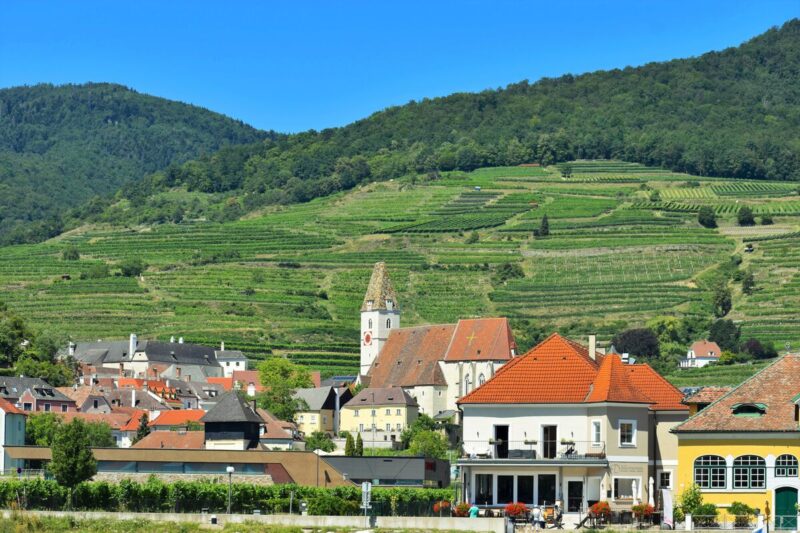

Spitz is one of those places that instantly feels special. Vineyards spill down steep hillsides right to the Danube, wrapping the village in green. The river feels so close, shimmering beside rows of grapevines while boats drift past.
It’s calm and unhurried. My mum and I loved wandering narrow paths through the vineyards, grapes hanging above us and glimpses of the river sparkling below. Hinterhaus Ruin is just a few minutes’ walk from here.
A slow walk in Spitz is one of the nicest things to do in the Wachau. River cruises glide by, adding magic and making it feel like your own quiet corner. It’s perfect for gentle walks, wine tasting, and soaking up lovely views without crowds.
Dürnstein


Dürnstein grabs you the moment you see its bright blue-and-white abbey tower rising above the Danube and rocky cliffs. From a Danube cruise, it’s that iconic Wachau view you’ll recognise straight away.
The village is small and squeezed between the river and steep vineyards. It’s full of narrow lanes, old houses, and little shops selling apricot sweets, wine, and local goodies.
My mum and I loved wandering here, popping into tiny shops and strolling quiet streets that often lead straight to the riverbank.
One of my favourite memories was spending nearly half an hour in the cool Danube right by Dürnstein, floating around and soaking up views of the vineyards and the abbey tower above.
My mum eventually dragged me out because she wanted some fresh, hot coffee instead of standing around in the breeze!
You can laze here with wine and views or hike up to the castle ruins. Dürnstein is one of the best spots in the Wachau Valley for fairytale vibes and local flavours.
Weißenkirchen in der Wachau


Weissenkirchen is smaller than Dürnstein, but it’s just as pretty in its own calm way. The first thing you’ll spot is the red-steeple church peeking out above rows of vineyards and old stone houses.
The village hugs the Danube, surrounded by sunny slopes covered in grapevines and narrow lanes lined with historic buildings.
It’s a place where you don’t need a plan. My mum and I wandered winding streets, passing stone houses and stopping at tiny wine taverns.
The air smelled of fresh wine and fruit, and we spent ages sitting by the river, watching boats drift past while the vineyards glowed in the sun.
A stroll in Weißenkirchen is one of the loveliest things to do in the Wachau Valley, perfect for soaking up quiet beauty, good wine, and stunning views.
Emmersdorf
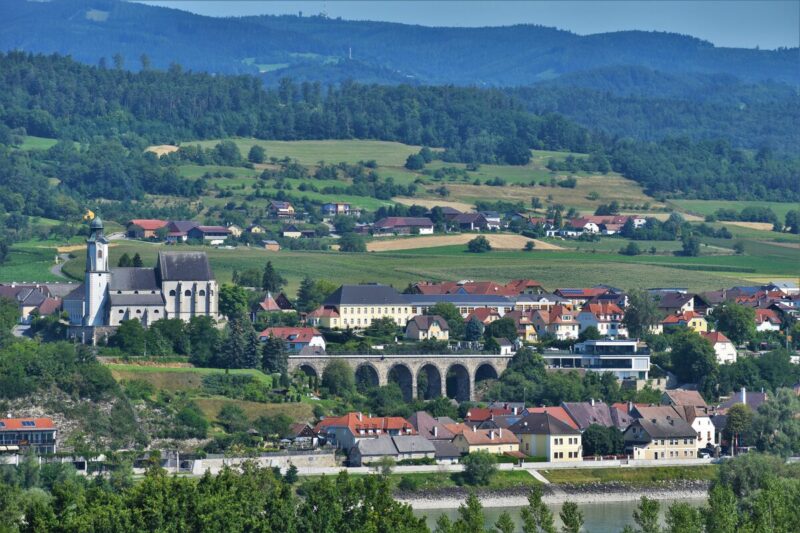

Emmersdorf sits quietly across the Danube from Melk, feeling smaller and more hidden than places like Austria’s pretty wine village Dürnstein or Weißenkirchen.
The first thing you’ll spot is the big arched railway bridge running through the village, surrounded by traditional houses and calm streets.
For me, Emmersdorf felt like a secret spot. I was curious about that bridge — for a second, I thought it was a Roman aqueduct! We ended up there after riding the Wachaubahn train through vineyard tunnels.
The higher you wander, the better the views get, with Melk Abbey glowing above and the graceful arches of the bridge below. My mum and I strolled uphill past gardens and old houses, finding quiet spots overlooking the river and hills, with barely any tourists around.
Exploring Emmersdorf is one of the hidden gems of the Wachau Valley, perfect if you love secret corners and charming views.
Visit beautiful Wachau Valley Abbeys
Melk Abbey


Melk Abbey, built in the 1740s, is one of the top Wachau sights for grand architecture and stunning views. This baroque masterpiece in yellow and white sits high above the Danube like a palace.
When I visited with my mum, we were both amazed. She usually skips churches, but even she loved the sunny courtyards, beautiful valley views, and the library filled with old books and colourful frescoes.
We used the audio guide ( add on to 16 euro entry ticket), which helped us explore at our own pace and learn the abbey’s fascinating stories.
Allow two to three hours to see it all, including the northern bastion and the ornate rooms. It’s easy to reach, either by 60 step uphill walk or a quick taxi the expensive ride from town.
Göttweig Abbey


Göttweig Abbey near Krems was built in the 1720s and often comes up alongside Melk Abbey when people talk about the Wachau. It’s well known with both travellers and pilgrims.
It’s grand and impressive, with sweeping views over Krems and the Danube. From afar, it looks like a fortress. When I first saw it from Krems Dock, I thought it was a castle.
Göttweig has stronger ties to the Hofburg imperial court than Melk, so it feels a bit more royal. Some travellers reckon it’s even more majestic than Melk, but without the big crowds.
The ticket costs around €14 and includes an audio guide, which makes it cheaper than visiting Melk Abbey.
If you want the same historic vibe as Melk but fewer people and a dash more imperial glamour, Göttweig Abbey is a great pick. It’s easy to reach by car and or taxi. Plan at least two hours to look around.
Durnstein Abbey


Dürnstein Abbey, built in the early 1700s, is one of the prettiest spots in the Wachau Valley — and definitely not just another abbey. Unlike Melk or Göttweig, it’s smaller and sits right by the river. That famous postcard shot with the bright blue tower? That’s this abbey.
For me, it blends small-village charm with gorgeous baroque touches. Seeing it peek through vineyards from a distance feels magical.
Inside the sunny courtyard, there’s even a clever mirror so you can admire the tower and painted ceilings from different angles without craning your neck.
The best bit is how easy it is to reach. The abbey sits in the heart of the village, so you can wander in straight from the cobbled streets — no hiking or steep climbs needed.
Compared to Melk’s grand vibe, Dürnstein feels smaller — and cheaper too, with entry around €9 — but it’s colourful, cosy, and perfect for a quick yet stunning stop.
Wachau Castles and ruins worth exploring
There are about 20 castles and castle ruins across the valley. Here I. have. picked best. 4 which I find worth visiting for their uniqueness
Artstetten Castle (Artstetten-Pöbring)

If you’re not planning to visit other active castles in Austria, Artstetten Castle 13km from Emmersdorf is worth considering to get a real taste of Austrian royal life, the Habsburg family, and architecture.
It’s not as towering as Neuschwanstein in Germany, but it sits among forests and gardens, with charming onion domes and sturdy white walls. Inside, there’s even a small collection of vintage cars.
The twist is Archduke Franz Ferdinand and his wife, Duchess Sophie, are buried here. His 1914 assassination sparked World War I.
The castle tells his story and how it led to war, mixed with plenty of royal details. So it is worth paying 15 EUR as the entry fees.
You can easily reach by bus or bicycle from Melk. You get dropped almost at the entrance — no hiking drama — which makes it great for visiting with kids and families.
Schönbühel Castle (Schönbühel-Aggsbach)

When I saw Schönbühel, about 4 km from Melk, while on a Danube cruise, I honestly thought Cinderella might appear — it’s that dramatic.
Surrounded by forests and perched on a rock 40 metres above the river, it’s all turrets and moats — like a storybook come to life. Built in the 1600s by a Noble family, it once had an underground “Bethlehem” with caves recreating holy sites from Israel.
Sadly — visitors aren’t allowed inside anymore. When I went in 2022, there was still a parking lot and ticket counter, but it had already been taken over by a private real estate company.
Still, it’s one of the gorgeous places to see from outside or across the river, and it’s easily reachable by VOR bus.
Aggstein Castle Ruins (Aggsbach-Dorf)

ggstein Castle might be a ruin, but it’s one of the coolest places in the Wachau Valley for sweeping views.
Perched 300 metres above the Danube, it offers epic views of the river winding past green hills and tiny villages.
Being up there feels like stepping onto a medieval film set, with stone walls, secret passages, and crumbling towers perched on sheer cliffs. For the view it gives, the entry fees 9.5EUR is totally worth it for budget traveller.
Inside these ancient walls, some nearly 900 years old, there’s even a tavern and café. So while you might not be guzzling mead or feasting on wild boar like the knights did, you can still sip Wachau wine and apricot dumplings, all while sitting in centuries-old stone rooms.
It’s about 14 km from Melk, and you can drive right up or hike from villages like Aggsbach Markt. Don’t miss the tiny chapel and the “Rosengärtlein” prison, said to be escape-proof.
Hinterhaus Ruin (Spitz)

It’s just a 750-metre walk from Spitz Donaustation up a gentle path through gorgeous vineyards to reach Hinterhaus Ruin. This fortress, around 800 years old, once belonged to the powerful Kuenring family, who pretty much ran trade and river tolls in the medieval Wachau.
Sitting above Spitz and wrapped in vines, the ruin feels rugged and dramatic – No entrance fees, just your energy to hike up.
It’s not huge, but its crumbling towers and walls give off pure medieval vibes. No fancy café here — just quiet ruins, lovely views, and that secret-spot feeling.
If you fancy a scenic wander and love exploring hidden places without crowds, Hinterhaus in Spitz is one of the best walks in the Wachau Valley.
Ruins of Dürnstein Castle (Dürnstein)


Sitting above the pretty village of Dürnstein are the famous castle ruins where Richard the Lionheart was once held prisoner.
He’d fallen out with Duke Leopold V during the Crusades and ended up locked up here on his way home — which is why this place pops up in so many legends.
The hike takes 15–20 minutes up a rocky path through vineyards. It’s a bit of a workout but doable for most.
At the top, you get brilliant views over the Danube, the green slopes of the Wachau, and the iconic blue tower of Dürnstein Abbey below. The castle itself is mostly crumbling walls, but it’s perfect for photos and soaking up the medieval atmosphere – So it is free for visitors.
There’s no café up there, but back in town, you’ll find plenty of cosy spots to sit and refuel after your climb.
Wine and vineyard experiences of Wachau valley
Domäne Wachau

Domäne Wachau is one of the most famous wineries in the Wachau Valley, just outside Dürnstein.
They run vineyard tours on Saturdays from June to October for about €22, but private tours on weekdays can cost up to €190 — a bit steep if you’re travelling on a budget.
I was keen to visit, but since I was in Dürnstein midweek, the price was too high for me and my mum. So instead, we chatted with a local in a coffee shop, who kindly got us into his friend’s grape farm.


It wasn’t a full wine tasting, but we wandered through the vines and learnt why October is the best time to visit for harvest and winemaking. Even seeing the grapes and hearing a bit about Grüner Veltliner felt special.
Winzer Krems

If Domäne Wachau feels too pricey, Winzer Krems is a good alternative. It’s a modern winery offering guided tours through cellars, interactive exhibits, and tastings for a fair price.
You’ll learn about grape growing, wine making, and even smell different aromas used in tasting notes
Outdoor activities to try
Danube Cycle Path


Many travellers come to the Wachau for cycling. And who could say no to smooth bike paths with the Danube on one side, castle ruins above, and villages tucked among vineyards?
The EuroVelo Route 6 runs right through the valley, and you’ll sometimes spot cyclists riding all the way from Germany to Slovakia! I even met an American in Melk who’d cycled from Vienna and was planning another 50 km to Krems.
But you don’t have to go that far. Even renting a bike for a couple of hours in any village and rolling along the river is one of the loveliest ways to soak up the Wachau’s beauty.
Walking and hiking


My absolute favourite thing to do in the Wachau Valley is walking and hiking. There’s nothing like sunshine, the Danube breeze, and stopping for cheese and wine in old taverns.
I don’t think there’s a single corner of the Wachau that isn’t pretty on foot.
If you’re feeling adventurous and have more time, there’s the 180 km Wachau World Heritage Trail linking 13 towns, with views of castles, vineyards, and the river.
But if you’re like us and only have a couple of days, it’s lovely just picking short paths around the villages or strolling from one place to the next. And whenever your feet give up, there’s always a bus or the Wachaubahn train to get you further along the valley.
Taking a scenic danube cruise


One of the best ways to see the Wachau Valley without spending a fortune is hopping on a Danube cruise. A one-way trip from Melk to Krems costs about €39 and lets you see most of the valley’s castles, villages, and vineyards all in one go.
The open deck offers amazing 360-degree views — castles in the distance, pretty houses on one side, and vineyards on the other.
It’s not local transport but pure sightseeing. Along the way, you’ll hear stories reaching back to the Palaeolithic era.
Summer heat can make the top deck a bit much, but there’s lower-level seating with air conditioning. My mum and I hid there for a while when the sun got too fierce!
Wachau Valley local food and drinks
Wachau local food

One of the best parts of visiting the Wachau for me was all the delicious food — especially anything made with apricots, or Marillen.
I saw them everywhere, turned into jams, brandy (Marillenbrand), schnapps, cakes, and my absolute favourite: Marillenknödel dumplings. I think I tried them in every village we visited, and they were always delicious!
Locals also love Wachauer Laberl, crusty rolls perfect with cheese or Liptauer, a creamy paprika spread.

And as someone who’s vegetarian, I skipped the Danube fish, but made up for it with fruity strudels, currant berry slices, and way too many sweet rolls from the bakeries.

Traditional Heuriger Wine Taverns
One of my favourite ways to taste the Wachau was relaxing in cosy Heuriger taverns like Weinschenke St. Michael, serving crisp wines and simple homemade food like cheese, spreads, pickles, and bread under leafy vines.

For sweet treats and budget-friendly snacks, I loved popping into village bakeries and market stalls. The blackcurrant pastry I picked up in Melk’s square might just be one of my favourite bites of the whole trip!
What to skip in Wachau Valley


Krems is skippable if you’re after the true countryside vibe the Wachau Valley is famous for.
It’s the biggest town in the valley, full of busy streets, shops, and historic spots like Göttweig Abbey and old castles. It’s got more of a small-city feel, and lots of people enjoy it for the museums, the Rathaus, and shopping.
But for me, Krems doesn’t have the same charm as the smaller villages. It’s lively and has plenty to see, but it feels louder and more urban compared to places like Spitz or Dürnstein.
Unless you’re staying longer and want a city base, you might be happier focusing on the smaller, cosier places instead.
That’s my take on the best things to do in the Wachau. It’s full of beauty, history, and delicious treats without breaking the bank.

Let me know if you’re planning a 2- to 3-day trip like we did, or if you’re lucky enough to spend a whole week there — I’ll be jealous if you choose the latter! I really feel the Wachau has so much to see and experience, and one week is essential to do it justice.


