
Disclaimer: Some links in this post are affiliate links. If you book through them, we earn a small commission at no extra cost to you. See our Privacy Policy for details.
DIY Walking Tour Guide of Hiroshima Peace Memorial Park
Hiroshima Peace Memorial Park isn’t like other spots in Japan. Visiting here feels heavy—it’s a place for reflection, not for quick photos.
August 6th, 1945—known as Hiroshima Day—marks the city’s unimaginable tragedy from the atomic bomb. Today, Hiroshima is vibrant but remains dedicated to remembrance.
That’s why the Peace Memorial Park and Museum are here.
Of all the places we visited on our first Japan trip, the Atomic Bomb Memorial of Hiroshima holds a special place in our hearts.
It isn’t beautiful in a traditional sense, but it’s a visit everyone should make. You won’t feel ‘good’ here, but you’ll leave hopeful.
Sometimes, we just sat in silence, taking it all in—the exhibits have that power. Here, you don’t rush. Sometimes, you need silence—no interruptions.
This blog helps you plan your DIY visit to Hiroshima Peace Park so you can wander at your own pace and understand it all, without being rushed.

Hiroshima Peace Memorial Park DIY guide Overview
Recommended Walking Route through the Park
The Hiroshima Peace Memorial Park is massive—spanning over 120,000 square metres and home to more than 10 different monuments and landmarks.
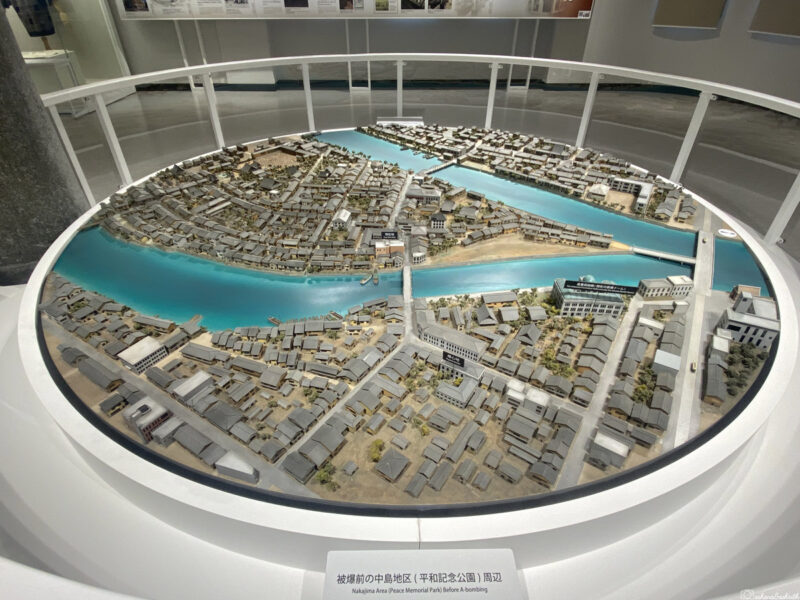
To start with your DIY Walking tour of the park I’d definitely say go straight to the Atomic Bomb Dome. It’s the most famous spot, and seeing it in person is quite something.
Then, make your way over to the Rest House which also serves as a tourist information centre and exhibition space.
We stopped there too, and it’s a solid spot to pick up a map and get a sense of what Hiroshima was like before 1945.
Knowing that backstory adds a lot to everything you’ll see next.
Here’s the order I’d recommend for your self-guided tour of Hiroshima Peace Park and it needs about 1.5km of walking.
- Atomic Bomb Dome
- Rest House
- Children’s Peace Monument
- Bell of Peace
- Atomic Bomb Memorial Burial Mound
- Flame of Peace
- Prayer for Peace Memorial Statue
- Hiroshima Victims Memorial Cenotaph
- Hiroshima Peace Memorial Hall
- Hiroshima Peace Memorial Museum
Map of Peace Memorial Park
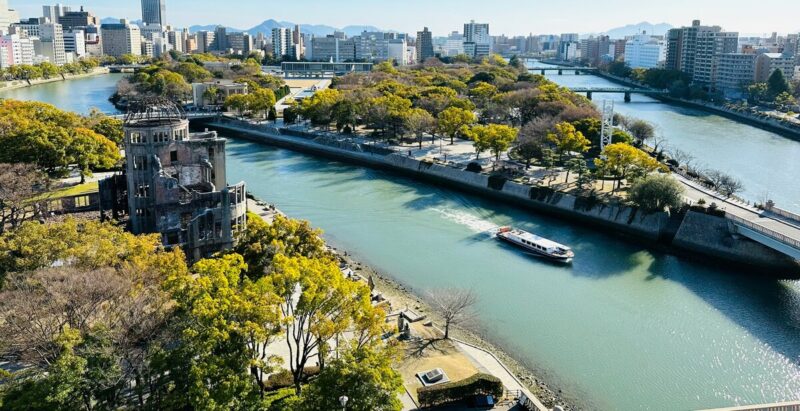
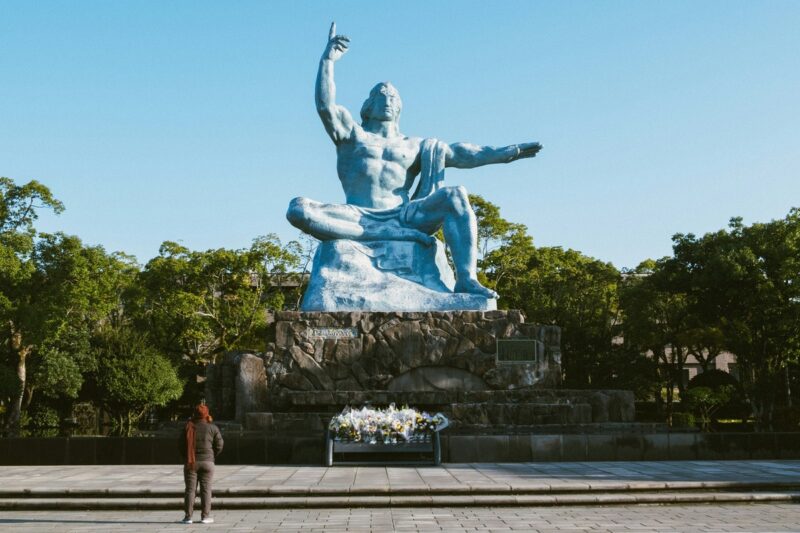
Quick Overview of Hiroshima and Nagasaki Bombings
The Hiroshima and Nagasaki bombings brought staggering loss of life and remain etched in history.
On August 6, 1945, the U.S. dropped the atomic bomb “Little Boy” on Hiroshima, killing around 140,000 people by the end of the year.
Three days later, on August 9, the bomb “Fat Man” hit Nagasaki, resulting in approximately 70,000 deaths by year’s end.
The cities lie on different islands, with Hiroshima on Honshu and Nagasaki on Kyushu, about 400 kilometres (250 miles) apart.
These attacks marked the only use of nuclear weapons in warfare, turning both cities into lasting symbols of peace and resilience.
Hiroshima Peace Park and Nagasaki Peace Park were built to honour the victims of the atomic bombings and to serve as reminders of the devastation caused by nuclear warfare.
Both parks symbolise hope, resilience, and a commitment to peace, urging visitors worldwide to work towards a future free from nuclear weapons.
Hiroshima Peace Park self-guided highlights
1. Atomic Bomb Dome (Genbaku Dome)
So, first thing you’ll see in Peace Memorial Park during your self guided walking tour is the Atomic Bomb Dome, also called Genbaku Dome

They’ve got a “before and after” photo here showing how it looked pre-bombing. It was built in European-style architecture in 1915 by a Czech architect. as the Hiroshima Prefectural Commercial Exhibition Hall.
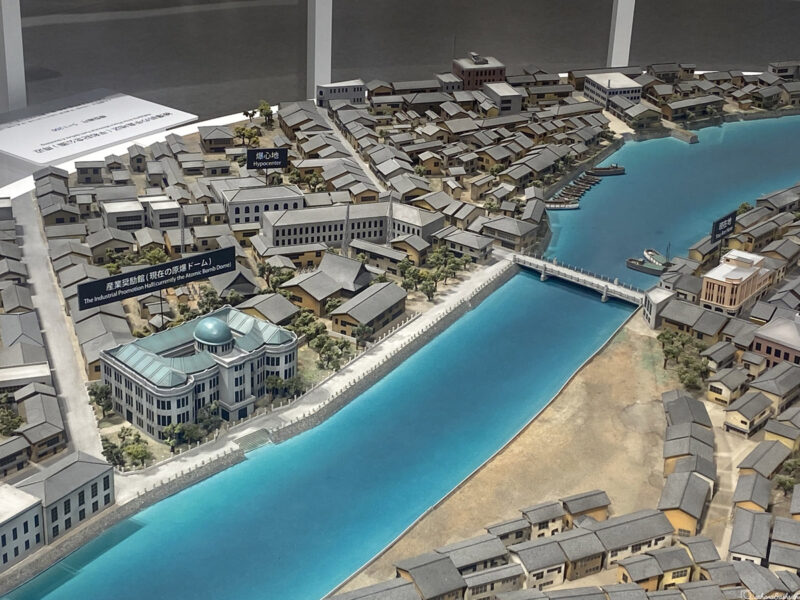
Here’s something most people don’t realise: this isn’t the hypocentre—the exact spot where the bomb hit. That’s actually about 200 metres away at Shima Clinic.
But it’s the Dome that’s become the symbol of Hiroshima’s devastation.
On that day of bombing, everyone inside was burned alive, yet somehow, part of the building survived.
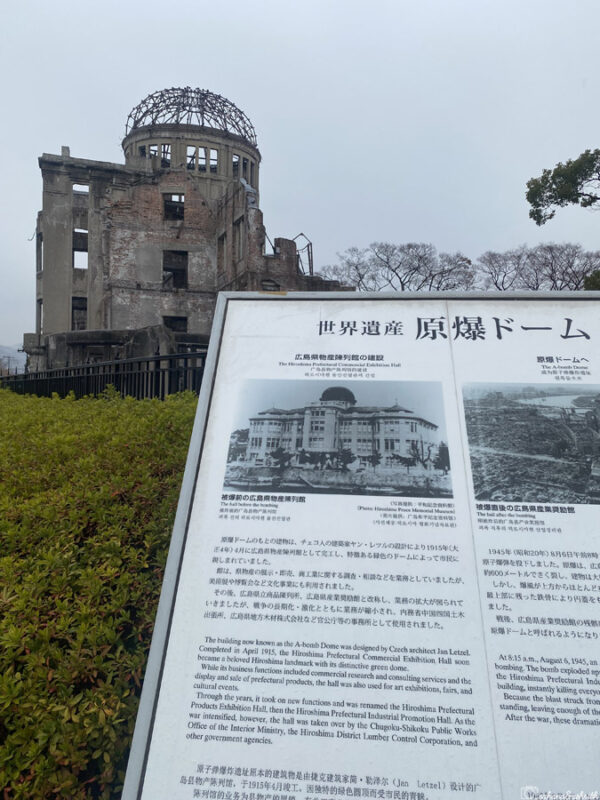
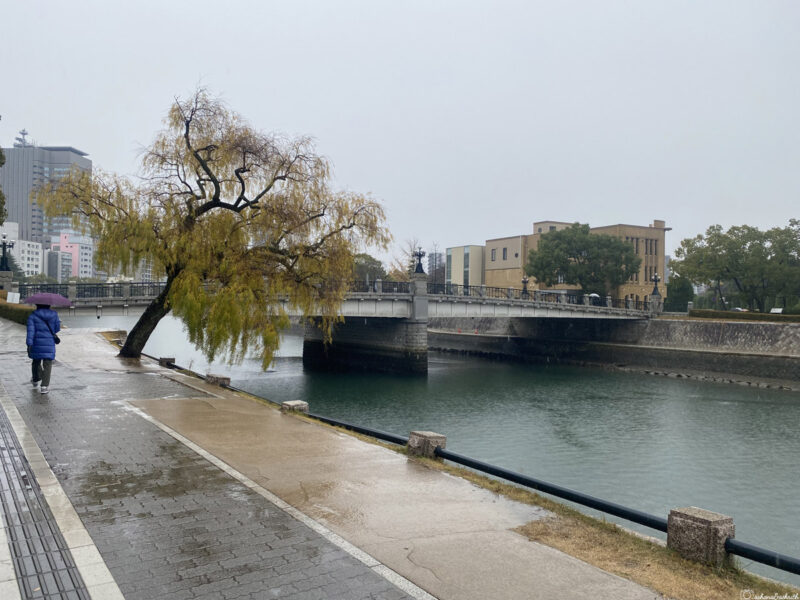
It’s like this skeleton of a structure that refused to fall, witnessing it all. The canal nearby, with its peaceful greenery, feels almost romantic, but there’s nothing of romance here—just stark horror.
Since it’s in an open park, the Dome is accessible 24/7, free of charge, and even lit up at night. We saw it while going to Nagataya for some okonomiyaki for dinner
The Debate on Preservation
There was a lot of debate after the bombing about whether the Dome should be preserved or removed. Some thought it should be erased, too painful a reminder.
But I’m glad they kept it as it is in 1966. It’s a testament, almost like it’s saying, “Look at what happened to this city, but also look at how we’ve rebuilt.” It’s powerful.
Can You Enter the Dome?
No, you can only view it from the outside, probably for safety.
Significance as a UNESCO World Heritage Site
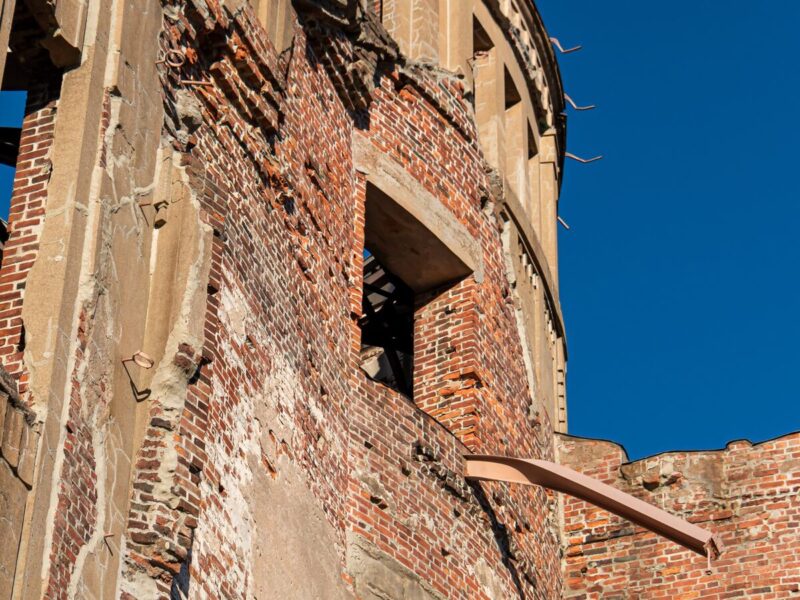
The Genbaku Dome (Genbaku means atomic bomb in Japanese) is the only structure left standing near the hypocentre from August 6, 1945.
Today, it’s not just a memory of the past but a call for peace, a quiet but powerful reminder to the world: no more Hiroshima Days, ever again.
2. Rest House of Hiroshima Peace Park
Honestly, more than anything, the Rest House felt like the real eye-opener in Hiroshima Peace Park.
Without visiting it, I don’t think we’d have understood the devastation as deeply as we did.
On the ground floor (Japan’s first floor), there’s a tourist centre where you’ll find all the info you need about the 1945 atomic bombing.
Grab a map here—it’ll make your self-guided tour of the park way easier.
Here’s something a bit strange—just like the stamps you collect at temples (like we did at Kamakura’s Big Buddha and some temples in Nara), you can get a stamp here too.
We actually hesitated at first, thinking, “This isn’t a happy place, why stamp it?” But then we learned about the story in the basement, and we decided to take it as a reminder.
And then there’s the basement and upper floor, which house a museum.
Why the Basement of the Hiroshima Rest House Matters
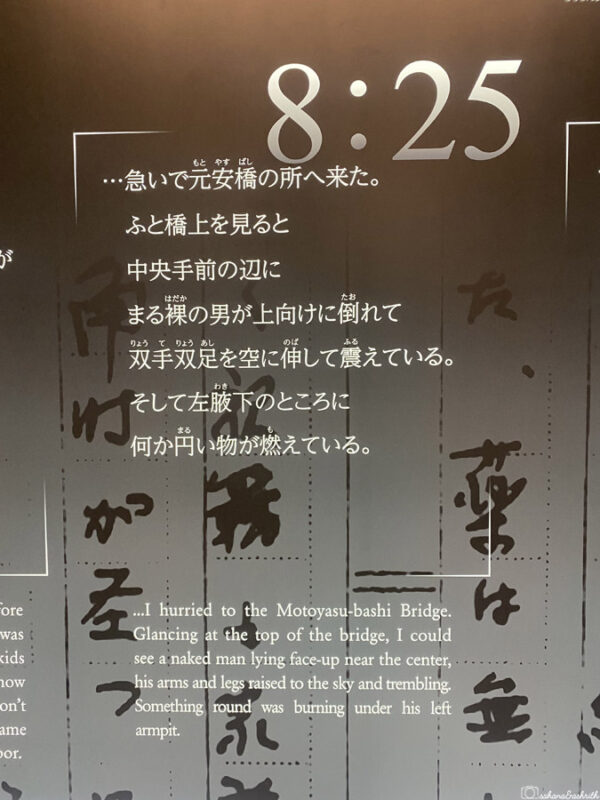

The Rest House started as a kimono shop, later became a fuel distribution centre, and was built in 1929. On August 6, when the bomb hit, the roof caved in, and sadly, all 37 workers inside died—except one man, Eizo Nomura.
The Story of Eizo Nomura, the Survivor
Nomura was just doing his job that day, heading down to the basement, which had a concrete roof, to grab some documents. Just before 8:15, the bomb dropped.
He was knocked unconscious, but the basement’s structure partially held, protecting him. When he came to and made his way out, he was greeted by scenes too horrific to even imagine.
I felt something soft, like a straw bag being under my feet. Weird. I touched it softly with my hands. It was half buried in the sand. “No way! It’s a person!” I picked him up, called out, and tried various things, but he did not move at all. He seemed to be already dead. I suddenly began to shudder – From the memoirs of Nomura.
Against all odds, Eizo Nomura recovered from his injuries and lived until 1982.
He passed away at 72, his life marked by unimaginable survival and resilience. That basement stands as a silent witness to his story and a reminder of the fragility of life.
3. Children’s Peace Monument
Out of all the monuments in Hiroshima’s Peace Park, the Children’s Peace Monument is probably the one that hits hardest—it’s dedicated to the kid Sadako Sasaki and the countless innocent children who lost their lives due to the bombing.

The monument stands as a tribute to all the children who died from the atomic bomb’s effects, but Sadako’s story makes it especially moving.
Who Was Sadako Sasaki?
Sadako was only 2 years old when the bomb dropped. She was at home, about 1.7 kilometres from the hypocentre, and while she didn’t suffer immediate injuries, ten years later, she was diagnosed with leukaemia—a direct result of radiation exposure.
After spending eight months in the hospital, Sadako passed away surrounded by her family.
The Children’s Peace Monument is a 6-metre-tall bronze structure with a statue of Sadako holding an origami crane.
Origami, with its Japanese roots, is one of the coolest things you can buy in Japan and is often seen as a bit of a brain teaser. But here at Hiroshima Peace Park, it means so much more—symbolising hope for world peace.
According to local legend, folding 1,000 paper cranes grants a wish, so Sadako began folding cranes in the hope of recovery, though she only made hundreds before she passed.
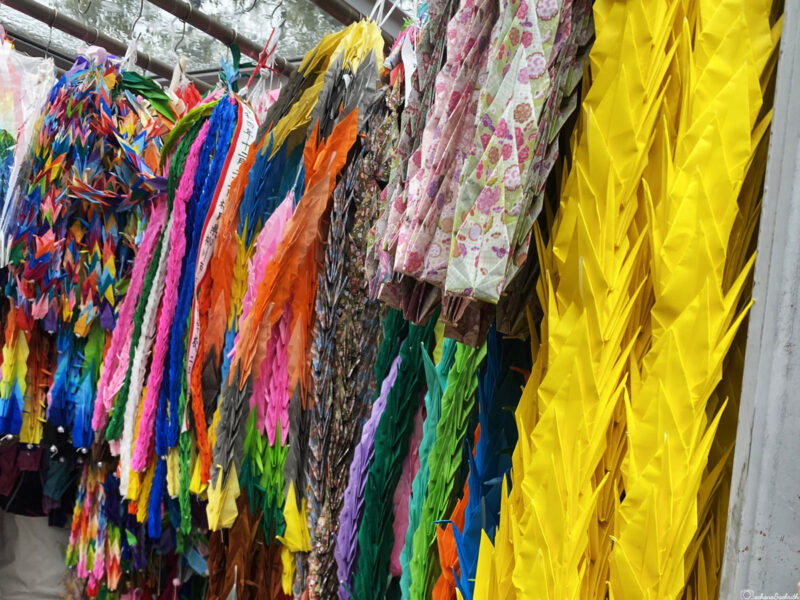
This ritual has since become a powerful symbol of hope and resilience.
Today, the monument is surrounded by thousands of colourful paper cranes sent by children from all over the world, each symbolising a wish for peace.
On certain days, you’ll find school groups gathering here to fold and dedicate cranes to Sadako—a touching reminder that her story continues to inspire.
4. Bell of Peace
The Bell of Peace is one of three peace bells in the park, with this one specifically symbolising world peace.
You may have rung bells at Shinto shrines in Kyoto, or even at local restaurants in Japan.
But ringing the bell here at Hiroshima Peace Park feels different—it’s not about spirituality or joy.
Visitors are encouraged to ring it as a prayer for world peace, a solemn act that resonates with the park’s purpose.
When I rang the bell, the deep, echoing sound felt almost like a chant, carrying the cries of those who suffered on that tragic day.
The bell itself has inscriptions in Greek, Japanese, and Sanskrit, all sharing messages of unity, peace, and self-awareness.
It’s a powerful reminder that peace isn’t just a concept—it’s something we have to keep striving for.
5. Atomic Bomb Memorial Burial Mound
If there’s one monument here that isn’t for the faint-hearted, it’s the Atomic Bomb Memorial Burial Mound. This grassy knoll holds the ashes of thousands of unidentified victims from August 6, 1945.
Not everyone who lost their life that day could be identified.
Beneath this mound, the vault still holds their ashes, and every year, names of newly identified victims are added, hoping that any remaining family members may come forward.
It’s a quiet but heavy reminder of the immense human cost of that day of Hiroshima Nuclear attack.
6. Flame of Peace
Hiroshima Peace Memorial Park isn’t just about marking the tragedy—it’s a call to the world to create a future free from nuclear weapons.
This message is symbolised by the Flame of Peace, which burns near Peace Pond.
The flame itself was sourced from the eternal flame at a temple on Miyajima Island.
Even on a rainy December day when we visited, it burned steadily, as it has since 1964. It’s set to burn until the last nuclear weapon on Earth is destroyed.
The design of the structure symbolises hands pressed together, reaching upwards in prayer.
Incredibly, the Flame of Peace aligns in a straight line with the Atomic Bomb Dome and the Memorial Hall.
It also honours the survivors’ desperate thirst for water after the blast, as many ran to rivers and ponds seeking relief.
7. Hiroshima Victims Memorial Cenotaph
Probably the second most photographed spot in Hiroshima Peace Memorial Park is the saddle-shaped cenotaph.

It holds the names of all atomic bomb victims and is designed so the arch perfectly frames the Flame of Peace.
The epitaph reads, “Please rest in peace, for we shall not repeat the error.”
This cenotaph not only honours the victims but also stands as a commitment to peace.
Every year, on August 6th—known as “Hiroshima Day”—a remembrance ceremony is held here, with thousands of paper lanterns floating along the Motoyasu River.
If you’re in Hiroshima on that day, it’s a powerful, unforgettable sight.
8. Prayer For Peace Memorial Statue
The Prayer for Peace Memorial Statue, a striking figure of a mother holding her child on a crescent moon, stands right in front of the Pond of Peace.
This statue is dedicated to all victims who held onto hope and peace, even amidst the chaos of the atomic bombing.
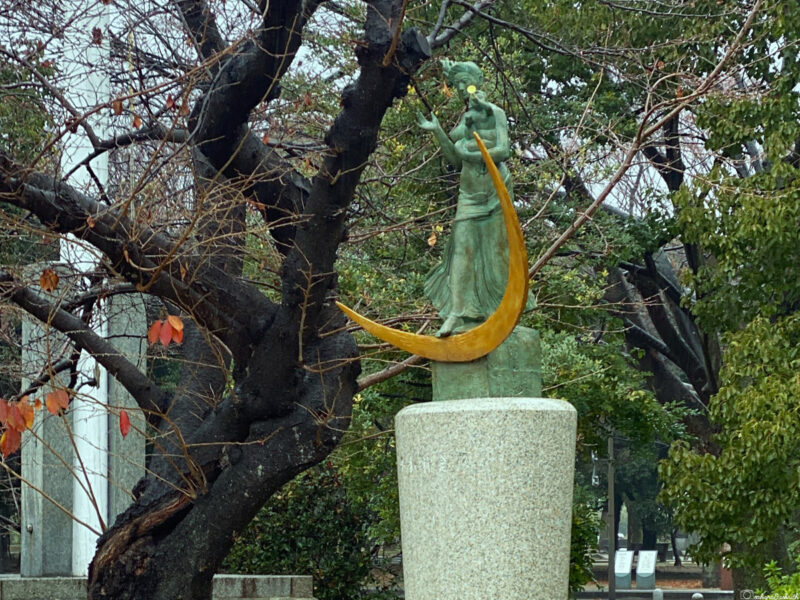
It’s one of the few monuments in the park that brought a sense of calm and positivity amidst all the sorrow.
The mother and child embody the resilience of the human spirit and our unbreakable desire for peace, even in the face of overwhelming adversity. It’s a reminder of the strength within us, and somehow, it left us with a feeling of hope.
9. Hiroshima Peace Memorial Hall
As you walk through the park, on the eastern side, you’ll spot a clock stuck at 8:15—the moment the bomb hit Hiroshima.

Water flows around it like a cascade of tears. Follow the steps down to the basement, and you’re led into the Hiroshima Peace Memorial Hall – a place dedicated to mourning and remembrance.
The Hall of Remembrance: Circular Hall with a 360-Degree Panoramic Photo
It’s lined with a panoramic photo of Hiroshima after the bombing, as seen from the hypocentre (Shima Hospital).
The wall is made up of about 140,000 tiles, each tile representing a life lost by the end of 1945.
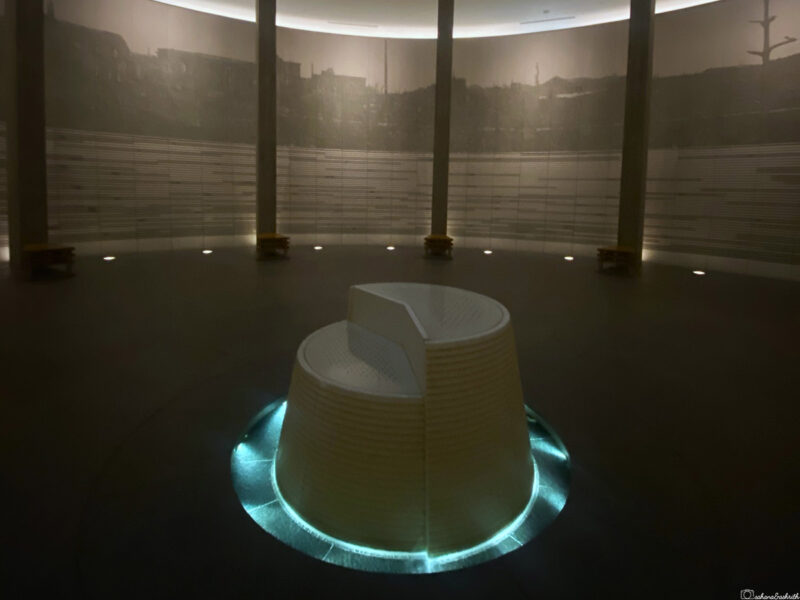
Below the photo, they’ve marked the towns that existed before the bombing, grounding you in the reality of everything that was destroyed.
The Upper Level: Special Exhibition Area
As we made our way out, we noticed a sign for a 30-minute film. “Enjoy a thirty-minute film presentation on our large projection screen.”
The word “enjoy” on the sign gave me a moment of hope—maybe it was about Hiroshima’s recovery?
But the video started with scenes of life in Hiroshima on August 6, 1945, just before the bomb dropped.
It quickly moved to images and stories that were heavy and gut-wrenching. The story of Kinue Tomoyasu especially broke me (and probably everyone else in the room).
Kinue, one of the survivors, was searching for her daughter by the riverbank on August 7.
Bodies were everywhere, and she couldn’t tell who was alive. She called out, holding a yukata for her daughter. Finally, she heard a faint voice: “Mother, it took you so long.”
When she reached her daughter, she found her covered in maggots, with yellowish pus oozing from her wounds.
Her skin was peeling, and there were so many maggots Kinue couldn’t wipe them all away. Her daughter was taken to the hospital and passed away nine hours later.
That story—and others shared in this hall—make the horror of that day painfully real.
10. Hiroshima Peace Memorial Museum
The final stop on your self-guided itinerary through Hiroshima Peace Memorial Park is the Hiroshima Peace Memorial Museum.

Located about 200 metres from the Memorial Hall, this main building holds deeply personal items, like victims’ clothing and fragments of buildings destroyed by the bomb.
While most monuments in the park are symbolic, the museum brings you face-to-face with actual objects from that tragic day.
You’ll see things like a melted lunch box from the intense heat, torn clothes, broken bicycles, and half-destroyed watches—each item a haunting reminder of lives abruptly ended.
The museum itself is divided into two buildings.
The Main Building focuses on the victims and the effects of radiation, with personal items that convey the devastation.
The East Building provides context, detailing the history leading up to the bombing.
It also has a video guestbook, where visitors, including figures like former U.S. President Barack Obama, have left messages of peace.
You can even rent an audio guide to get more out of your visit, and there’s a small café to take a break.
You need to pay an entrance fees to visit this museum

How to Get There
To reach Hiroshima Peace Memorial Park and Museum, you’ve got a couple of easy options. You can hop on a tram (streetcar) or take the loop bus.
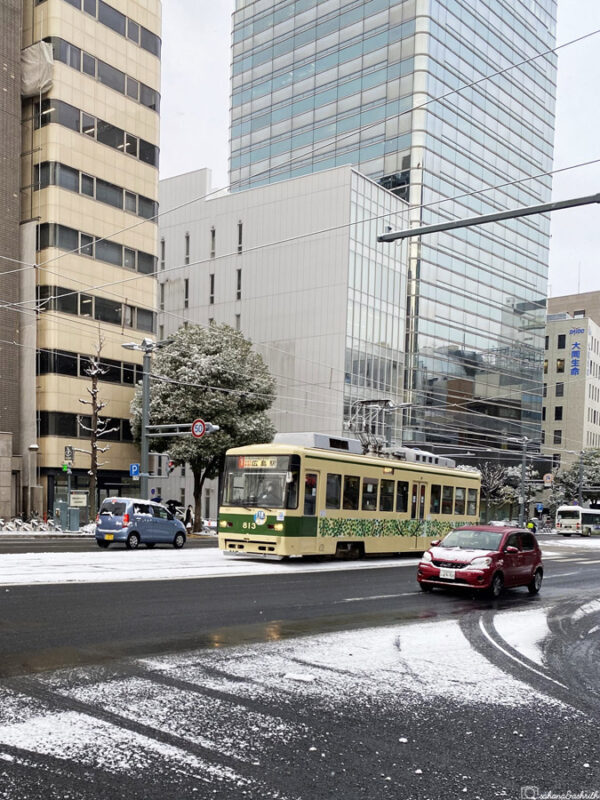
If you’re staying nearby, like in Kanayamacho as we did, it’s actually close enough to walk—just about a kilometre, which makes for a nice stroll.
The nearest streetcar stop is Genbaku Dome-mae Station—right across from the Atomic Bomb Dome.
If you’re taking the bus, get off at the Peace Memorial Park stop. Just a heads up: the bus drops you off on the museum side of the park, not near the Dome.

Planning Your Visit
Best season to visit Peace Memorial Park
The season to visit Hiroshima is from October to the third week of December, when crowds and prices tend to be lower. Although the cherry blossom season in spring is popular, it’s also crowded.
Best Time of the day to Visit
The least crowded times at the Peace Memorial Park are in the morning before 11 am and late afternoon after lunch. Plan your visit during these hours for a quieter, more quieter experience.
How Much Time Should You Spend?
Plan for 2-3 hours to explore the Hiroshima Peace Memorial Park’s main monuments, museum, and memorials comfortably
Entry Costs and Accessibility
The park is free to enter, but the museum has a small entry fee. Most areas are wheelchair accessible, with ramps and elevators provided.

Special Tips for Visiting Peace Memorial Park
What to Bring for a Comfortable Visit
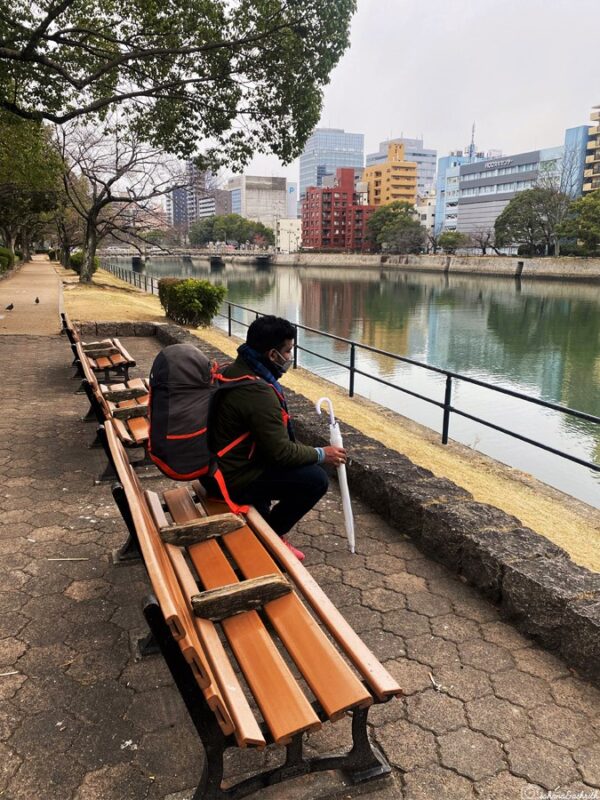
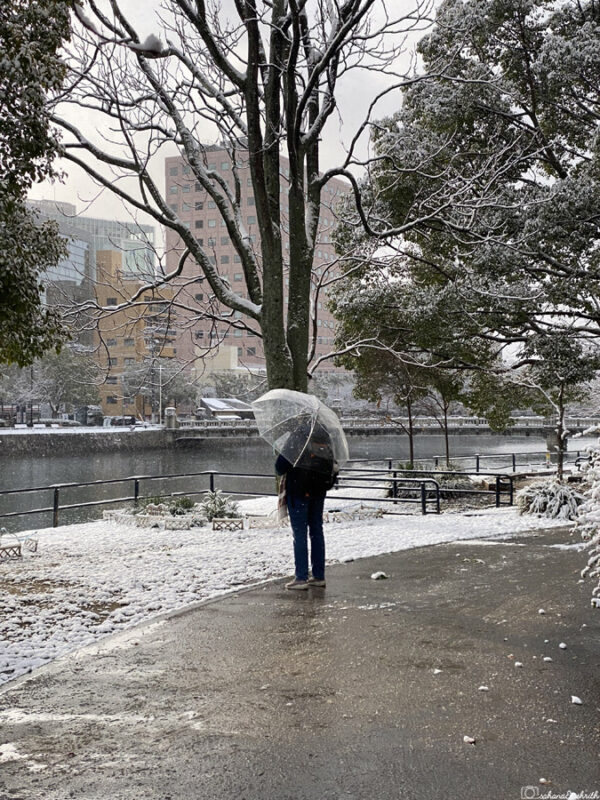
Bring water, comfortable shoes, and an umbrella for shade or rain. Grab a map at Rest House – it was super helpful for us to navigate the main sites.
Recommended Etiquette in the Park
Keep voices low, respect memorials, and avoid taking selfies at sombre locations. The park is a place for quiet reflection and respect.
Nearby Attractions to Explore After Your Park Visit
Explore Hiroshima Castle, Motoyasu River and Its Banks, Shukkeien Garden, or Hondori Street shopping district, all within a short walk or tram ride.
Restaurants and Cafes Near Peace Memorial Park
There’s a café on the upper floor of the Hiroshima Peace Memorial Museum, but it’s pricey and limited. For more options, cross the bridge over the Motoyasu River.
Around the park, you’ll find plenty of spots, including Nagataya—famous for its delicious okonomiyaki (veg and non-veg), open from 11 am to 8:30 pm.
Final Thoughts
Who would choose to rest in a place that brings back memories of such devastation? But for us, the whole point of Hiroshima Peace Memorial Park isn’t just about remembering the pain.
It gives you a similar experience to that of Dachau Concentration Camp in Germany.
It’s a message from the city, showing us how they moved forward despite everything they lost.
Walking through the park, we couldn’t help but feel overwhelmed by the sheer sorrow tied to each monument, each clock frozen at 8:15.
Every step took us back to that day in 1945, and for a moment, it was hard to see beyond the tragedy.
But then we realised—the park isn’t only a place of grief; it’s asking us to consider something bigger. It’s about peace, resilience, and a city that refused to stay defined by one terrible event.
Each memorial, each story shared here, reminded us that Hiroshima is so much more than a city that was bombed. By keeping these memories alive, they’ve built a powerful symbol of hope.
Frequently Asked Questions
Can You Visit Hiroshima Peace Memorial Park for Free?
Yes, entry to Hiroshima Peace Memorial Park is free. However, the Hiroshima Peace Memorial Museum within the park charges a nominal fee.
Are Guided Tours Worth It or Should You DIY?
DIY tours are ideal for Hiroshima Peace Memorial Park, as detailed guides are available in English. With a self-guided tour, you can take your time at each site, allowing for reflection and a deeper understanding. Guided tours can feel rushed and tend to be more expensive.
Where Can You Get the Hiroshima Peace Memorial Park Stamp?
You can obtain the Hiroshima Peace Memorial Park stamp at the Rest House within the park. This facility serves as a tourist information centre and offers various exhibits, including the commemorative stamp
Where to stay near Hiroshima Peace Park
The best areas to stay near Hiroshima Peace Memorial Park are Hatchobori and Kamiyacho in Naka Ward. Both neighbourhoods got budget-friendly business hotels to luxury options, and are conveniently close to the park and main attractions.


