
Disclaimer: Some links in this post are affiliate links. If you book through them, we earn a small commission at no extra cost to you. See our Privacy Policy for details.
10 Stunning Places to Visit in Sikkim : Sikkim Travel Blog
Sikkim, the Himalayan gem in northeast India, is truly charming. As the second smallest Indian state, it has an unexpected number of beautiful places to visit.
Back in 2017, Sikkim was one of India’s hidden gems, like Lakshadweep. Now, with its beautiful lakes, rivers, hiking trails, and Buddhist monasteries, it’s popular among travellers.
The best part is, it’s still not crowded and hasn’t been spoiled by mass tourism.
After exploring Sikkim for two weeks, I can say I’ve seen a lot of it. My spouse, Ashrith, loved it so much he biked around it twice! We’re pretty much Sikkim pros.
We know many folks get confused about which places to visit in Sikkim. There are monasteries everywhere, high-altitude spots, and permits to consider. And you have a lot of things to do in Sikkim including Trekking and Paragliding.
We get your situation. So, in our Sikkim travel blog, we’ve listed the top 10 places to visit.
With these, you can easily plan a 7, 10, or 14-day trip without relying on tourist packages that miss out on some gems.
To know practical details on reaching and getting around Sikkim, packing essentials, and safety and health precautions, read out our detailed post.
Gurudongmar Lake near Lachen
Gurudongmar Lake in North Sikkim is the most magical place to visit in Sikkim. Nestled at 17,000 feet above sea level, this glacial and holy lake is surrounded by snow-covered mountains.
In winter, the lake freezes except for a small part, which is believed to have been blessed by a Sikh Guru and remains unfrozen. This part is also the drinking water source for Lachen.

Since Gurudongmar Lake is close to the China-occupied Tibetan region, it’s a protected area. So Indians need a Protected Area Permit (PAP) to visit Gurudongmar lake. Foreign nationals can only go as far as Chopta Valley, 33 km before the lake, and aren’t allowed to the lake itself.

To visit Gurudongmar Lake, you’ll need to stay in Lachen the night before and start the journey early in the morning.
The route from Lachen to Gurudongmar Lake is one of the most scenic in all of Sikkim. You pass through small hamlets, rocky mountains with snow, and then comes the amazing cold desert. On the way, you might even spot wild yaks and barking deer!

In our opinion, Gurudongmar Lake is the most beautiful place in Sikkim. Ashrith’s quest to visit this stunning lake led him to bike through Sikkim twice, while I was lucky enough to see the gorgeous lake on my first trip.
Ashrith wasn’t lucky the first time because visiting Gurudongmar isn’t easy.
Getting a PAP isn’t hard, but the weather after Lachen must be in your favour. As one of the coldest regions in Sikkim, storms and heavy rainfall are common.

In winter, from December to January, the road to Gurudongmar Lake is often closed. During other times, you can visit it from early morning until 12:30 pm. This means you need to start from Lachen by 4 am. The 40 km journey from Lachen can take up to 3 to 4 hours!
The Indian Army mercilessly closes the road even during other seasons when the weather worsens?for our own good.

Yumthang Valley near Lachung
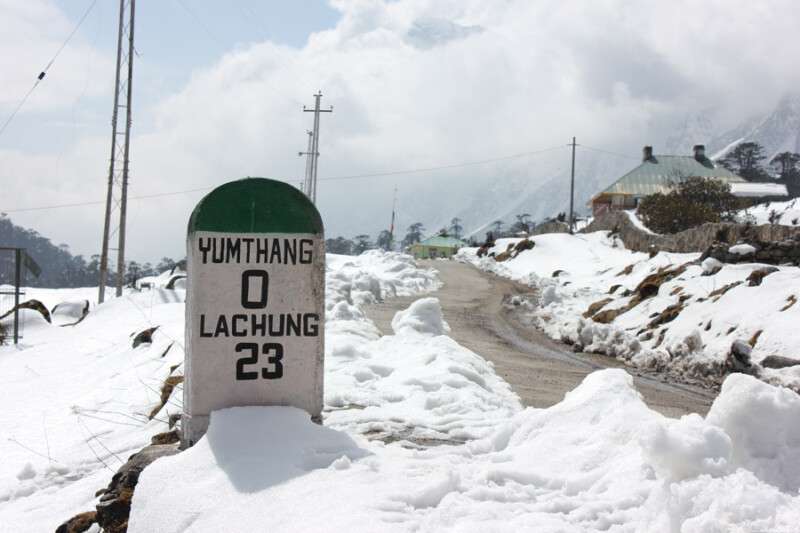
Yumthang Valley, near Lachung in North Sikkim, is perfect if you love snow and flowers. Sitting at about 11,800 feet, Yumthang changes with the seasons. In winter, you can make snowmen or roll on the ice by the river while admiring the green forest. In spring, from February to mid-June, it turns into a floral paradise.

Yumthang is Sikkim’s most famous tourist spot due to its easy accessibility and stunning beauty.I suggest spending two days to enjoy its serene beauty Anything more can get overwhelming because of the crowd.
Both foreign and domestic travellers can visit Yumthang with a Protected Area Permit (PAP).
If you go ahead from Yumthang Valley for about 25 km, you’ll reach a place called Zero Point, also known as Yume Samdong, which sits at 15,300 feet above sea level. It’s a vast open ground surrounded by hills covered in snow during winter and often in spring.

Don’t expect 3-foot-high snow, but it’s definitely less crowded than Yumthang Valley. If you want to explore further, there are many hot springs around!
Before heading from Yumthang to Zero Point, check if the road is in usable condition. Sometimes it goes to the dogs and becomes unusable.

The best way to get to Yumthang valley is by bike or private car. There’s no public transport, so shared taxis and group tours are budget-friendly options.
To reach Yumthang, take the road from Gangtok to Chungthang, then turn right to Lachung, the starting point of Yumthang.
Gangtok
A state’s capital city in most Indian states often gets over-commercialised and loses its charm. I don’t know what magic tricks the Sikkimese used, but Gangtok is charming without getting over-commercialised despite being the state capital.
In fact, it isn’t a city, but a town!
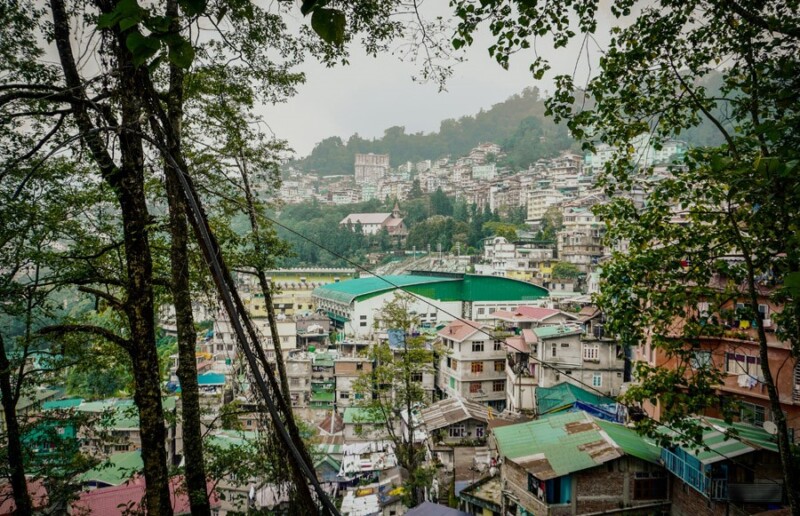
Indian travellers don’t need any permit to visit Gangtok, but foreign nationals require an Inner Line Permit (ILP).
The sleepy yet vibrant town makes you never want to leave this terraced city. The green hills, hiking trails, monasteries, karaoke clubs, shopping markets, organic vegetable markets, and plenty of Tibetan food make Gangtok a great place to spend 2-3 days.
Hiking to higher points of the town like Ganesh Tok and Hanuman Tok is fun for those who are fit.
Adventure junkies can go paragliding. Peace lovers can drive to Rumtek Monastery from Gangtok. Nature lovers can make a lot of day trips here.

Or just wander along MG Road, eat a lot of momos, and sip lemon tea!
Spending two to three days in Gangtok can be either full of adventure or very relaxing – it’s up to you.
Rumtek Monastery
Need a break from the city? Rumtek Monastery near Gangtok is your go-to spot for serenity.
Tucked away in a forest, the monastery offers a peaceful escape with its vast courtyard, traditional Tibetan architecture, and Buddhist chants. If possible, be there at 6AM for the main ritual – It was the best thing I did in Sikkim – the chants are really hypnotic!
Located at about 4,800 feet, Rumtek Monastery is best visited as a day trip from Gangtok. You can get there by private vehicle, cycling, or booking a taxi from the Gangtok taxi stand.

No special permits are needed for Indian travellers. Foreign travellers need a Restricted Area Permit (RAP) to visit Rumtek Monastery, which can be easily obtained at the Gangtok office.
The monastery gets so quiet during the non-tourist season, like in February when I went, that when the chants stop, you can hear yourself breathing.
It is best to make a day trip to Rumtek from Gangtok by private vehicle. You can go cycling or biking to get there. Or just book a taxi from Gangtok taxi stand for a day to visit Rumtek and Lingdum Monastery.
Tsomgo Lake
Tsomgo Lake, also known as Changu Lake, is a crystal-clear glacial lake in East Sikkim, sitting at about 12,310 feet. Nestled among snow-capped mountains, the lake’s colours change with the seasons?from icy blue in winter to lush green in summer.
Less crowded than other nearby spots like Nathu La, Tsomgo Lake is hugged by two mountains, creating a stunning view. But don’t expect it to be empty!
What made me like Tsomgo Lake better than other lakes in Nathu La is that it was less crowded. Two mountains hug the lake from each side, and the way these mountains terminate and meet at a point makes it feel like the lake water is about to become a waterfall.

Tsomgo lake falls under protected areas of East Sikkim. Indians need to obtain a Protected Area Permit (PAP) prior to visiting Tsomgo lake. And Foreigners with ILP can also visit Tsomgo lake after obtaining extra PAP.
You can see the mountains behind, between the gaps where the two mountains meet, with the turquoise blue water at their foothills.
Just like at Nathu La, you can ride yaks around the lake here. But honestly, I don’t recommend it! They weren’t meant to carry humans.
Nathu La
Nathula Pass, located in East Sikkim at 14,140 feet, is the most popular tourist spot in the state.
Apart from being a scenic beauty with lakes and mountains, it holds historical significance as a major corridor between India and Tibet before it was closed in 1962 during the Sino-Indian War.
Reopened in 2006, it now serves as a key trading post between India and China.
I have been to the Amritsar Wagah border (Indo-Pak border). Although Nathu La at the Indo-China border feels different. Of course, the landscape with mountains and lakes makes a big difference.
It is probably the closest you can get to China while standing on Indian land.
Standing beside Chinese soldiers and looking across the border is a unique experience.
The Indian army personnel are really polite and answer most of your questions if you aren’t being nosy and if the place isn’t too crowded.
Nathu La is a protected area, so Indian visitors need a Protected Area Permit (PAP). Foreign travellers are not allowed.
The only thing I didn’t like about Nathu La is the crowd. Being the most famous tourist destination in Sikkim, it receives the highest number of visitors.
It is just 60 km from Gangtok, and the mountains, lakes, and beautiful landscape, along with the chance to see China on the other side, excite tourists. So the place turns out to be noisy. Some irresponsible and careless tourists treat Indian and Chinese soldiers on the other side as props for their picture backgrounds.
Then, of course, the yak riding is more common here than at Tsomgo Lake – So it really gets “too much” at times.

During my visit to Nathu La in February, although it was off-season, I felt irritated by the overwhelming crowd and left the place within 45 minutes.
Thambi View Point, Zuluk
Most places along the ancient Silk Route go through deserts or historic cities. But here in East Sikkim, Zuluk got mountainous road as part of the Silk Route.
What makes Zuluk one of the top places to visit in Sikkim is the Thambi Viewpoint at 11,200 feet. Here, you can see the iconic zigzag roads that hug the green mountains like a serpent, with the Kanchenjunga range as a backdrop.
It was the connecting road between Bhutan and China via India. I am really confused if Zuluk serpentine road scene is more beautiful than Gurudongmar. Let’s just say they contend with each other.
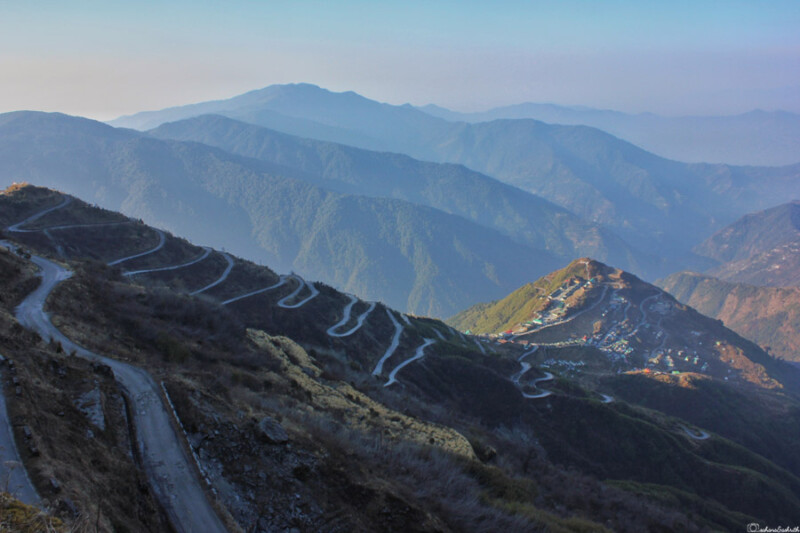
Zuluk falls under the protected areas of East Sikkim. Indians need to obtain a Protected Area Permit (PAP) before visiting, and foreigners are not allowed in Zuluk.
Apart from the viewpoints, there are some unique places near Zuluk. Visit the Baba Harbhajan Singh Mandir, a temple dedicated to an Indian soldier, and the cosy hamlet of Padamchen, where you can enjoy a traditional breakfast in home-run cafes. Don’t miss the Lingdum Monastery either.
To visit Thambi Viewpoint, it is best to stay at Lingtam the previous night, like I did, and get to the viewpoint early in the morning for the best experience. The roads may get crowded by noon, and fog often covers the view as the day progresses.
Ravangla
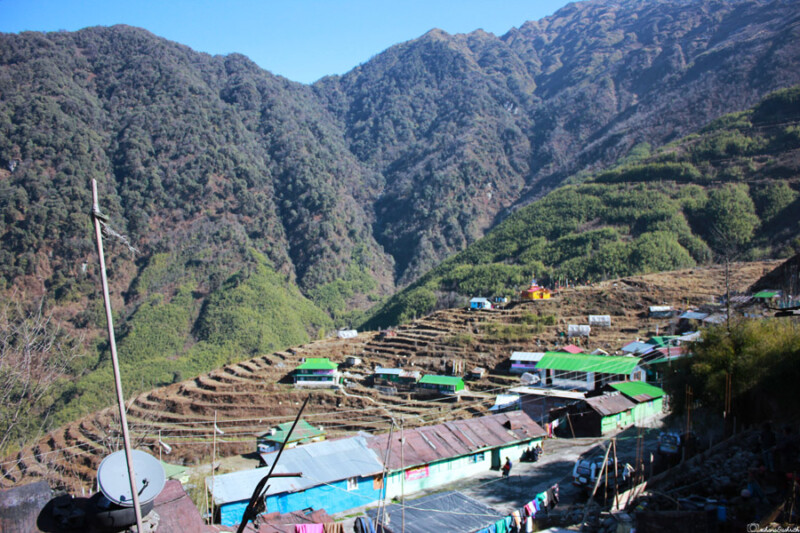
After touching the cold and holy water at Gurudongmar and witnessing the sunrise over the incredible views of the snakelike winding road, I thought I had seen the best of Sikkim. There couldn’t be a more quietly serene place than Zuluk, I thought, until I went to Buddha Park in Ravangla.
The Sikkim government opened the park at 7,000 feet with a 40m tall Buddha statue in 2013 to develop tourism along the Buddhist pilgrimage circuit.
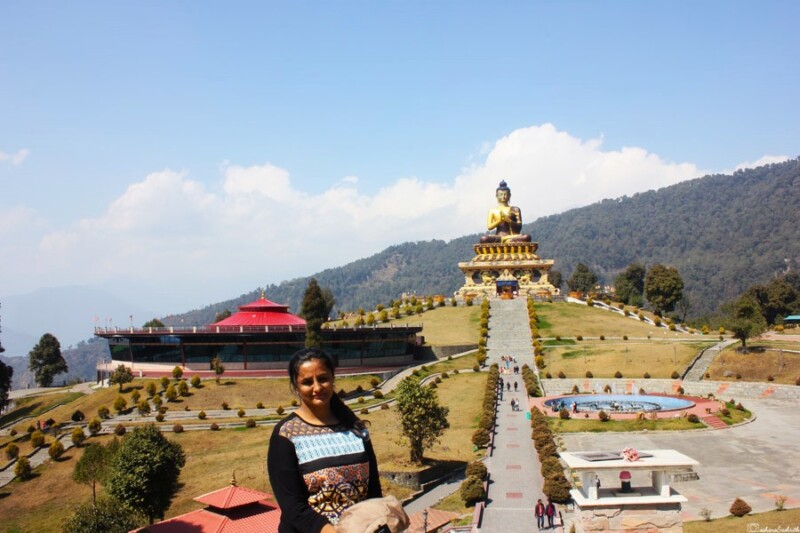
I wondered how I fell in love with a “made for tourism” religious place! The main monastery is Ralang, home to 200 monks. Many Buddhists visit this 250-year-old monastery due to its actual religious significance.
If you’ve read my other posts, you know my love for old and heritage buildings.
The whistling wind, the flapping sound of Buddhist prayer flags, and soothing chants enhance the beauty of this park, hugged by mountains.
The inside of Ravangla Temple, which you enter at the base of the Buddha statue, is colourful and tells the story of Buddha’s life.

Indian travellers don’t need any permit to visit Ravangla as it doesn’t fall under protected areas. Foreign nationals with an Inner Line Permit (ILP), which is mandatory to enter Sikkim, can visit Ravangla by obtaining additional permit Restricted Area Permit (RAP)
I am not a follower of Buddhism, but I could feel the spirituality and holiness in a “made up” religious place like this.
Plus, I always wondered what’s so special about having Maggie in the mountains. Here, the Maggie they make in local shops on a cold morning, makes you realise the hyped concept of “Mountain Maggie.”
Accommodation options in Ravangla are limited as most tourists opt to stay in Pelling or Namchi. So, making a day trip to Ravangla is better.

Pelling
Pelling, located in West Sikkim at an altitude of about 7,200 feet is all about hiking trails leading to ancient palace ruins or monasteries, quaint villages, and plenty of cafes.
In most parts of Sikkim, the view of Kanchenjunga is the highlight. If you’re unlucky like me and the weather is always cloudy during your travels, you might not see Kanchenjunga despite spending 10 days there. But don’t lose heart?Pelling is here for you with its views of Kanchenjunga, visible from almost every corner of the town.
So on one morning, I woke up at 4 am, and the view of Kanchenjunga emerging from golden clouds made me scream with joy and brought tears to my eyes – It is in Pelling where I saw Kanchenjunga for the first time and watched it for as long as I liked.

Pelling doesn’t fall under protected areas, so Indians don’t need a PAP to visit Pelling. Foreign nationals can visit Pelling with the Inner Line Permit (ILP) they obtained upon entering Sikkim.
Pelling is everyone’s favourite?backpackers, city dwellers, honeymooners, big bus group travellers who visit Sikkim, wandering travellers like me, and writers and artists who stay for months.
But don’t worry about it being crowded like Shimla. It isn’t.

There are many hiking trails, like the Rabdentse Trail and Pemayangtse Monastery hike, where you can easily escape the crowd and meet friendly folks once you’re done being alone.

No wonder, some backpackers settle here for a week. As a flashpacker I suggest spending three days in Pelling – taking it easy and going slowly.
Yuksom
If you really want to unwind and do nothing in Sikkim, head to the town I adore most?Yuksom in West Sikkim, sitting at an altitude of 5,800 feet. Honestly, I never expected to enjoy those two days without any “things to do” checklist, but Yuksom surprised me.
Apart from those who go on the Goecha La trek, hardly any visitors come here. This makes Yuksom one of the least crowded yet most beautiful places to visit in Sikkim.

Yuksom is full of natural wonders. There’s nothing too big to boast about, just small yet charming spots. Kathok Lake, surrounded by woods, offers a serene escape. The hiking trail to Dubdi Monastery is perfect for a peaceful walk. You’ll find small cafes with no glamour but delicious tentuk and sel roti.
The Coronation Park, where Sikkim’s first king was crowned, adds a historical touch to the visit. You’ll discover small hidden stupas with colourful Buddhist prayer flags fluttering in the breeze.
Of course, the famous surreal Khecheopalri Lake is just 20 km away.
If you’re fit, you can cycle there, or you can take a shared jeep or rent a car for a few hours. You’ll find yourself at the holy Khecheopalri Lake, surrounded by woods (and some people). Spend a few hours here walking around, and you’ll lose yourself in this green paradise.
Yuksom doesn’t fall under protected areas, so no special permits are required for Indians to visit Yuksom. Foreign nationals need to obtain RAP
What I love most is the sense of community. You’ll see a few tourists unwinding and lots of locals going about their day. It’s truly a green paradise.
Yuksom isn’t about rushing from one attraction to another. It’s about soaking in the quiet beauty of a place where time seems to stand still.
Places that aren’t worth visiting in Sikkim
One place in Sikkim that isn’t worth visiting, in my opinion, is Namchi.
Namchi is like any other town in Sikkim, without anything particularly unique except for the tea estates. For someone like me, who hails from the Western Ghats of India where tea estates are common, these tea estates didn’t impress me much. In fact, the ones in Munnar, Kerala, are much more scenic.

To attract Indian tourists, Sikkim tourism built Solophok Chardham with a 26½ m high statue of Lord Shiva in a sitting stance.

Alongside this gigantic statue, they replicated twelve Jyotirlingas and the four Dhams?Badrinath, Jagannath, Dwarka, and Rameshwaram. However, this place is neither religiously nor historically significant, nor is it architecturally wonderful. Organized group tours often bring busloads of tourists here, making it crowded as well.
Namchi also has monasteries, which are common in any Sikkim town. I really wish I had spent those two days in Yuksom instead of Namchi! However, this is just my personal opinion. But given any time of the year, I don’t think Namchi is worth visiting.
FAQ
How to Visit Places in Sikkim?
To visit places in Sikkim, start by flying into Bagdogra Airport or taking a train to New Jalpaiguri Railway Station. From there, hire a taxi or take a bus to your destination. Within Sikkim, local taxis and shared jeeps are common for getting around.
Where can I go in Sikkim in December
In December, the best places to visit in Sikkim are Gangtok, Pelling, Ravangla, and Yuksom because these have bearable temperatures during winter with less snowfall and minimal roadblocks. North Sikkim isn’t recommended due to extreme cold and blocked roads. The northernmost place you can visit in December is Yumthang
Places to Visit in Sikkim in March
March is an ideal time to visit Sikkim, just after winter. Almost all places are worth visiting, including Gurudongmar Lake near Lachen, Yumthang Valley near Lachung, Gangtok, Rumtek Monastery, Tsomgo Lake, Nathu La, Zuluk, Ravangla, Pelling, and Yuksom.
Places to Visit in Sikkim in May
The best place to visit in Sikkim during May is Yumthang Valley, especially Shingba Rhododendron Sanctuary, where 24 varieties of rhododendron bloom, creating a floral gala. Additionally, all other beautiful places in Sikkim are open for visitors in May, provided there are no surprise weather changes
Which are the most visited place in Sikkim
Sikkim’s capital, Gangtok, along with Nathu La in the East and Yumthang Valley in the North, are the most visited places in Sikkim.
Can you recommend any hidden gems to visit in Sikkim
Hidden gems in Sikkim include Dzongu in North , a serene village with stunning views and rich culture; Rinchenpong in West , known for its tranquil environment and historic sites; Darap Village near Pelling in West , surrounded by waterfalls and hiking trails; and Barsey Rhododendron Sanctuary in Sikkim, a beautiful spot for trekking and rhododendron blooms.
What are the places to visit in Sikkim for honeymoon
For a honeymoon in Sikkim, consider visiting Gangtok for its unique city life and stunning views, Pelling for its calm ambiance and scenic beauty, Lachung and Yumthang Valley for breathtaking landscapes and serene surroundings,


Wow gorgeous! Never been before and slightly sad some of these foreigners like me cannot visit, but thanks for the amazing pictures and insight!
Hi Taisa. Thanks! Yeah, some of these places are restricted to foreigners sadly 🙁
Beautiful photos! I wish I were able to visit!
Hi Soni. You can visit some of the places upon obtaining special permissions .
Beautiful area. Gotta love the decorated horns on the yak! Some crocheting mama just ran out of things to create and the yak was next!
Hi Jolayne – So true!:D
Gorgeous! I like that you also mentioned what to skip.
Hi Stephanie. Thanks for stopping by. I really didn’t like Namchi – And I don’t want to over glority Sikkim saying every corners is beautiful 🙂
Gorgeous photos! Looks amazing 🙂
Thanks Kristen 🙂