
Disclaimer: Some links in this post are affiliate links. If you book through them, we earn a small commission at no extra cost to you. See our Privacy Policy for details.
Essential Guide to Train Travel in India by Indian Experts
When you travel across India, train journeys are a necessity. As the 7th largest country in the world, India relies heavily on Indian Railway Service.
While we Indians see it as a boon, first-time foreign travellers in India may find train travel in India a puzzle. Even Indians get confused while booking train tickets in their own country!
Sahana and I, both living in India for 30 years, have taken at least 30 train journeys here. I’ve even sent my motorbike to other states via trains for bike trips.
So, I know what works and what doesn’t when it comes to travelling by train in India.
In this travel guide, I’ll show you how to book Indian train tickets, where to book them, which class to pick, what you get in each class, what to wear and pack, and how to stay safe during your train journeys.
After reading this, you’ll be able to plan your India trip better and on a budget. After all trains are the cheapest and safest way to travel around India.

Are Indian trains safe to travel?
Out of all the transportation modes, trains are the safest option to travel across India. The number of accidents on Indian Railways is much lower compared to the roads. With evolving security systems, most train coaches now have CCTV installed.
The Indian Railway helpline works swiftly when approached. Additionally, Twitter has been the biggest tool to improve train journey safety and quality in India.
You need to be careful of your belongings for sure. You can’t keep them unattended like you would in Japan.
So, you still need to use a metal chain with a locker for your trolleys and bags on long Indian train hauls. Definitely, you can’t be flaunting jewels or a fat purse.

Is it dangerous for a woman to travel alone in Indian Railways?
It is safe for solo women to travel by train in India. Thousands of Indian women take trains every day.
Plus, when you book train tickets on Indian Railway websites, you have the option to choose “Single Lady” – the algorithms ensure that solo women are given seats next to other women.
The only concern about women travelling by Indian trains is that you may encounter some men who stare. Things are much better than before, but like in any other place, you might find a man trying to start a conversation with you.
To stay safer, it is best to get seated where families are sitting, avoid coupe coaches if you are alone, and be very firm and say no when strangers approach.
Like you would do anywhere else in India, stick to comfortable modest clothing when you take trains in India
Being honest, I find the areas right outside train stations the creepiest not just for women, for everyone.
Chain snatchers and pickpockets wander here more than anywhere else. So, if you arrive at the train station after dark, don’t venture out unless your host comes to pick you up. Or plan to arrive at stations only during daylight.

Types of Passenger Trains in India
There are more than 15 types of trains in India. The major 7 types of Indian trains you might be using as a traveller in India are as follows
1.Local or Passenger Trains: Slow trains that stop at every station, ideal for local journeys w rather than long-distance travel with more of Non-AC Coaches. For example, Bangalore to Mysore train.
2. Mail & Express Trains: These trains are faster and have a higher running speed, often called Superfast, but with no significant difference in facilities compared to other trains.
3. Rajdhani Express Trains: Extra-fast all-air-conditioned sleeper trains connecting Delhi with regional capitals, with meals included in the fare. Example, Bhopal to Delhi, Ahmedabad to Delhi.
4. Shatabdi Express Trains: Fast air-conditioned daytime trains covering distances of 400-800 km, with refreshments included in the fare. Example, Bangalore to Chennai, Bijapur to Goa.
5. Tejas Express Trains: Fast all-air-conditioned trains similar to Shatabdi Expresses, running on several routes with AC Chair classes.
6. Duronto Express Trains: Very fast long-distance trains linking major cities, often non-stop and sometimes faster than Rajdhani Expresses, with AC and non-AC sleeper options.
7. Vande Bharat Express Trains: India’s most modern trains with high speeds, offering AC Chair class and Executive Chair class, with refreshments included

Heads up : Although some folks tend to Vande Bharat Trains as bullet trains similar to those of Japan, these are not bullet trains.
Vande Bharat trains usually travel at speeds of 90 to 100 km/hr, with a maximum speed of 160 km/hr on the Agra-Delhi route. In contrast, Japan’s bullet trains regularly travel at 200 km/hr and can reach speeds up to 320 km/hr.
Train classes in india
2nd Class Unreserved Seats (GN): General seating with no-frills wooden or plastic seats, no reservations needed. The most crowded and cheapest of all coaches. People stand, sit on the floor, and if a seat is meant for 3, expect 5 people scooting over! Fun, but you need to be an experienced traveller to take this.
2nd Class Reserved Seats (2S): Basic seats made of wood or plastic in an open-plan setting, similar to GN coaches but not as crowded since these seats need to be reserved in advance.
1st Class (F or FC): Featuring 2 or 4 berths in compartments, this class is nearly extinct, replaced by the fancier AC2.
Chair Car (CC): Similar to European 2nd class, these air-conditioned carriages have 2+3 seating arrangements.
Executive Chair Car (EC): Think of it as European 1st class, featuring 2+2 seating in an air-conditioned, open-plan setup.
Executive Anubhuti Chair Car (EA): A few lucky Shatabdi Express trains boast these fancy seats with perks like seat-back TVs.
Sleeper Class (SL): The masses travel here in open-plan carriages with upper, middle, and lower berths, no air conditioning. The berths have just a cushion upholstered with resin. It can be a bit noisy, but it’s comfier than sitting for long journeys. You’ll find plug points near the berths and also at the end of each coach.
AC 3-tier Economy (3E): A thrifty twist on AC 3-tier, with an extra berth squeezed in along the aisle.
AC 3-tier (AC3 or 3A): Triple the fun in air-conditioned comfort with upper, middle, and lower berths, complete with bedding.
AC 2-tier (AC2 or 2A): Enjoy the breeze in these open-plan carriages with upper and lower berths, all air-conditioned with bedding included.
AC First Class (AC1 or 1A): Chill out in air-conditioned luxury with 2 or 4 berths and bedding to boot. Generally called Coupe, they are like rooms without attached toilets. Meals are generally included. AC1 or 1A are the most expensive of all the seats on Indian trains.


How to book Indian Railway Tickets?
You can book Indian train tickets online, at railway station kiosks, or through travel agents in the city. The best way remains online booking, as you can reserve your tickets in advance. Popular routes like Delhi-Agra, Goa-Hampi, and Mysore-Trivandrum fill up quickly.
Make sure to carry a printed ticket along with your ID card. Although sometimes they say the email with PNR status is enough, it’s better to be safe than sorry!
Which website is used to book Indian train tickets?
IRCTC is the most used website for train ticket booking in India. Unfortunately, it is one of the most inconvenient and not at all user-friendly websites, but you have to deal with it.
You can use international credit and debit cards, net banking, or Indian digital wallets to book tickets.
Fortunately, IRCTC has provided a detailed manual on how to book tickets on IRCTC website. You may get irritated in the beginning, but have patience. It is worth traveling by Indian trains to save a lot of money that you would otherwise spend on flights.
Can you book Indian railway tickets from USA?
Yes, you can book Indian Railways tickets from the USA. Foreign tourists and NRIs with valid passports can use the IRCTC website to book under the Foreign Tourist Quota up to 365 days in advance. Berth allocation notifications are sent via international SMS.
You can find the detailed guide for Foreign Tourist Quota booking. Read this step by step guide before booking.
Alternatives to IRCTC for booking train tickets in India
Besides IRCTC, you can check 12Go Asia or Bookaway for train tickets. They are as easy to use as buying something on Amazon.
Ixigo Train is also a popular website to book train tickets in India. However, these third-party online booking services list only popular routes and timings.
Beware of travel agents in popular tourist spots. Places like Madurai, Kolkata, and Varanasi have plenty of travel agencies that might issue fake tickets.
Sometimes they take money for an AC sleeper coach but issue non-AC Sleeper Class (SL) tickets instead. So, I strongly advise against booking your Indian Railways tickets through street agents.

Types of Indian Train Tickets
Each type of ticket comes with its own quirks and probabilities, adding a layer of strategy to booking train travel in India
Confirmed (CNF): A Confirmed (CNF) ticket guarantees you a seat or berth on the train. It’s the golden ticket, ensuring you can travel without any hassle, knowing your spot is secured.
Reservation Against Cancellation (RAC): RAC tickets offer a shared seat or berth that may convert to a full one if there are cancellations. It’s a bit of a gamble but often pays off, giving you a full seat as others cancel.
Waitlist (WL): A Waitlist (WL) ticket means you don’t have a guaranteed seat but are placed in a queue. Your position improves as cancellations occur. It’s a hopeful wait, keeping your fingers crossed for an open spot. Look for an alternate option if your waitlist (WL) number is more than 10. Usually, WL numbers within 7 get confirmed on the day of boarding. But beyond 10, it is pointless to wait.
General Waiting List (GNWL): GNWL is the most common waitlist type, especially for trains starting from the origin station. Your chances of confirmation are higher compared to other waiting lists, so it’s a popular choice for hopeful travelers.
Remote Location Waiting List (RLWL): RLWL tickets are issued for stations between the origin and destination. These have a lower chance of confirmation compared to GNWL, making it a trickier option for those boarding at intermediate stations.
Pooled Quota Waiting List (PQWL): PQWL applies to a set of pooled stations en route. These tickets often have fewer chances of confirmation since they cater to multiple stations, adding a layer of uncertainty to your travel plans.
Tatkal Quota (TQWL): Tatkal tickets are for those last-minute travelers who need to book a day before their journey. These tickets go on sale a day in advance and sell out fast, making them a lifeline for urgent travel plans, though they’re less likely to get confirmed.

Indian railway train ticket price
The cost of train travel in India varies by class and distance.
Approximately, for Second Class, travelling 100 km costs ?100. In Sleeper Class without AC, the cost for 100 km is ?200. For 100km distance in AC First Class (AC) costs about ?350.
Facilities provided in the Indian Railways
At Railways stations
All Indian railway stations will have separate men’s and women’s toilets with EWC or squat toilets and a jet spray or bucket with tap water. You won’t find toilet paper?the hygiene of the toilets depends on your luck.
You will have benches on platforms with shade overhead at the major platforms. Only major railway stations like state capitals or main tourist attractions will have paid luggage locker services.
All stations will have at least one shop selling snacks and bottled water. Bigger stations will also have small food joints and magazine shops.


The major transit hubs like Delhi, Bangalore, Mysore, and Mumbai will have multiple restaurant options, sometimes even Domino’s!
Signboards are mentioned in regional languages (India has about 22 major languages), Hindi, and English. Platform numbers are clearly stated in English numerals. Announcements of train arrivals, departures, and delays are made on loudspeakers in three languages.

Passenger Amenities on Indian Trains
Toilets– Each coach in Indian trains will have a pair of toilets at the end, typically one squat and one EWC. Cleanliness varies, but most of the time these toilets are usable (better than the ones I used in Greece).
Don’t be shocked if you see your waste falling directly onto the tracks while the train is moving?most Indian trains don’t have septic tanks. Recently, Indian Railways has started using “bio-digesters,” but they are currently only on a few trains.


Pillow and Blankets : In Indian trains, air-conditioned sleeper classes (AC 1st Class, AC 2-tier, AC 3-tier) provide blankets and pillows for passengers. Non-AC sleeper coaches do not offer these amenities, so you need to bring your own for comfort during long journeys
Charging points – Indian trains have charging points. Most air-conditioned sleeper classes (AC 1st Class, AC 2-tier, AC 3-tier) and some non-AC classes offer power sockets for passengers to charge their devices. Typically, each cabin has at least one power socket near the berths, with additional sockets in some coaches.
Wifi – There is no wifi on Indian trains.
Do you get food on Indian trains?
Yes, absolutely! Indian trains have food options aplenty. You can get grub from pantry cars, train-side vendors, and station kiosks.
For the choosy eaters, e-Catering services let you order online your favourites at major stops. They even cater to special needs like diabetic food, Jain meals, and baby food.
The food provided by IRCTC is safe enough to eat. But I don’t recommend food by vendors and hawkers who enter coaches when the trains stop at stations. They bring usually deep fried snacks which are usually unhealthy.
If you’re traveling by non-AC sleeper coach, meals aren’t included. Vendors come by with menus and carts to take orders, then deliver your food later.
All 3 Meals are included with your ticket on Shatabdi, Rajdhani, and Duronto Express trains. You won’t have a choice as their meals are set. But you can always specify if you need Veg, Non Veg, Jain food while booking tickets online.
As a teenager, I loved riding the Shatabdi Express because they didn’t just serve three meals a day but also snacks with juice, biscuits, cakes, and namkeens with tea or coffee at intervals. It’s like a moving buffet.
No matter which coach you’re in, you can always order your own meal online through the IRCTC e-Catering website or app. This has been a boon for everyone traveling on Indian trains.

How to book a meal in Indian Railways?
Booking a meal on Indian trains is a breeze! Just follow these steps:
- Head over to ecatering.irctc.co.in and pop in your PNR number.
- From the dropdown menu, pick your station for delivery.
- Check out the list of vendors and their menus, then make your tasty choice.
- Choose your vendor and the meal you want to feast on.
- Pay up either online or opt for cash on delivery. Voilà , your meal is on its way!
What to wear while travelling in train in India?
Clothing
Lightweight and Breathable Fabrics: Opt for cotton or linen clothes. They are comfortable and breathable, making them ideal for India’s hot and humid climate.
Comfortable Attire: Wear loose-fitting clothes. For women, salwar kameez, below knee pants/capris are great options, while men can opt for loose trousers or track pants and T-shirts.
Ankle length bottom wear – It is best to pick ankle length pants for both mena nd women as you have to use toilets. The toilet floors won’t be clean and anything flowy might make it uncomfortable to use squat toilets
Modest Clothing: Although Indian trains are generally safe for women, wearing modest clothing brings you more safety.
Slip-On Shoes: These are practical for overnight journeys where you might want to take your shoes off to relax but need to put them back on quickly when moving around.
Scarf or Shawl: A versatile accessory that can be used to cover up for warmth, protection from the sun, or as a pillow.
Hat or Cap: Useful for sunny days, especially if you have to wait on the platform.
Avoid Expensive Jewellery: It’s safer not to flaunt expensive jewellery or watches while traveling.
Layering: Trains can be cold due to air conditioning, especially in sleeper classes. Carry a light jacket or shawl to stay warm. Layers also help you adjust to the varying temperatures at different destinations.

What to pack during train travel in India
When you are taking trains in India, make sure to travel light. Use rucksacks and backpacks more. The trolleys with wheels might be difficult lift when you get into the trains.
Things to carry for your Indian train journeys
Train Tickets: Either printed or digital copies.
Identification: Passport for foreigners or Aadhaar, PAN, or Driving License for Indians.
Toiletries: Toothbrush, toothpaste, face wash, and moisturizer.
Medications: Any prescribed medications and a basic first aid kit.
Sunscreen and Insect Repellent: Useful for day travel and stops.
Mobile Phone and Charger: Essential for communication and entertainment
Power Bank: In case charging points are not available.
Earphones: For listening to music or to escape other’s noise
Travel Pillow and Blanket: Especially SL Class train journeys or if you aren’t ok with using blankets provided in train for other classes.
Luggage Lock and Chain: To secure your bags under the seat.
Money Belt: To keep your cash and important documents safe.

Tips for Train Travel in India
Pick your classes and trains carefully.
Traveling in an Indian train’s non-AC coach might save you some cash, but it can be a real endurance test, even if it’s not summer. You need to ask yourself if the ?1,000 savings are worth sweating like a pig in a sauna on wheels.
Book in Advance
India’s railways carry more people daily than the entire population of Australia! So, Indian trains aren’t just used for tourism, but they are a lifeline for Indians due to their vast connectivity and affordability.
Book at least 15 days in advance for less popular routes and a month in advance for popular tourist routes during peak holiday times?October to December and April to May.
Keep your tickets handy for Inspection.
During the journey, the Ticket Collector (TC) will ask to see your ticket and ID (passport for foreigners, Aadhaar/PAN/DL for Indians). This usually happens once but can occur multiple times. Failure to produce a valid ticket results in a hefty fine.
Expect Delays in Schedule
Indian trains used to be notorious for being late, with delays often over an hour. Now it’s much better, but you can still expect a 10-15 minute delay.

IRCTC timing of train
Use “Ixigo” to check the status of your trains. It shows the exact train running status in India.
Be There Early
Indian railway stations are crowded and large. As a first-timer, you’ll need extra time to find your platform. Crossing to other platforms often requires a lot of walking via skywalks without elevators.
Expect crowd at station

As Indian trains are the cheapest way to travel around India, millions of people take trains every day. During their waiting hours or layovers between two trains, many tend to sleep on the platforms. This may come as a shock to foreign travellers from developed countries, but people sleeping or sitting on railway station platforms is a common scene.
Railway platforms aren’t wheelchair friendly
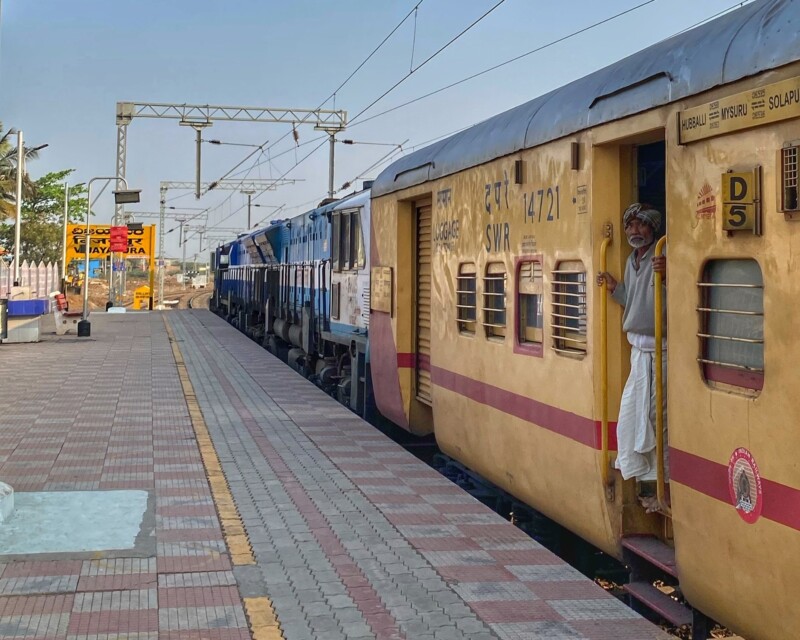
To get into the train from the platform, there are usually three steps.
Unlike in Austria, where platforms and train floors are at the same level, making it easy for baby strollers or wheelchairs to slide in, Indian train platforms are not wheelchair accessible.
Keep your belongings safe
Lock up your luggage, and don’t leave it unattended when nature calls. Bring a padlock and chain to fasten your bags under your seat. Theft is a sneaky culprit, especially at night when the train stops, so keep your valuables out of sight.
Bring Noise Cancellation headphones
Across India, it’s common to see people blasting music or watching videos on their phones without headphones. You can hear three songs and two news channels all at once! I never step into an Indian train without my trusty noise-canceling earphones?it’s the only way to preserve my sanity amidst the sound chaos.
Expect transgender individuals begging on trains.
When the train stops for over 15 minutes, beggars with kids and eunuchs often enter. Some beg, while others demand. Occasionally, transgender individuals may bully passengers for money. It’s best to give ?20 to ?50 quickly and let them move on.
Talk to fellow passengers with your guard up.
Indians are very friendly and curious about foreign travelers. They might be shy at first but become chatty later. It’s always good to have conversations with locals. However, don’t trust everyone completely?keep your guard up. Don’t reveal your next destination, hotel address, or all your whereabouts.
Check for luggage storage in train stations prior to arrival.
Only major railway stations in India have paid luggage locker services. So, if you want to dump half your luggage and pick it up later, check in advance and plan accordingly.

Tourism trains In india
The Deccan Odyssey
- What it covers: Maharashtra, Madhya Pradesh, Gujarat, Rajasthan, Karnataka
- Where it starts: Mumbai
- Cost: Starts around $6,500 per person
- Unique experience: Offers a royal experience with lavish interiors, gourmet dining, and cultural excursions, reflecting the opulence of the Deccan dynasties.
Maharajas’ Express
- What it covers: Delhi, Agra, Many parts of Jaipur, Mumbai
- Where it starts: Delhi
- Cost: Starts at $3,850 per person
- Unique experience: Known for its regal decor, personalized service, and off-train excursions to iconic landmarks, providing a travel experience akin to a mobile palace.
Palace on Wheels
- What it covers: Rajasthan, including Jaipur, Udaipur, Jaisalmer, Chittorgarh
- Where it starts: Delhi
- Cost: Starts at $5,390 per person
- Unique experience: Blends heritage and luxury with royal carriages, exquisite dining, and guided tours, each coach reflecting the rich heritage of Rajasthan.
Golden Chariot
- What it covers: Karnataka including Mysore, Hampi and Goa, Kerala, Tamil Nadu, Puducherry
- Where it starts: Bangalore
- Cost: Starts at $3,150 per person
- Unique experience: Provides a unique experience with luxury cabins, fine dining, and visits to historical sites, showcasing the cultural richness of South India.
Royal Rajasthan on Wheels
- What it covers: Rajasthan, including Jaipur, Jodhpur, Udaipur
- Where it starts: Delhi
- Cost: Starts at $3,600 per person
- Unique experience: Features opulent interiors, gourmet cuisine, and excursions to royal palaces and forts, offering a regal journey through the vibrant state of Rajasthan.
Bharat Gaurav Train
- What it covers: Holy destinations across India, including Jyotirlinga Darshan, Ayodhya Kashi Punya Kshetra Yatra, Puri Kolkata
- Where it starts: Various major cities
- Cost: Varies based on package and itinerary
- Unique experience: Tailored for Indian pilgrims, these all-inclusive packages ensure a comfortable and comprehensive pilgrimage journey, covering travel, accommodations, meals, and insurance.
Most Scenic Train Routes in India
Mumbai to Goa (Konkan Railway)
This journey on the Konkan Railway is a visual treat, with lush greenery, rivers, and tunnels. Watching the Western Ghats and Arabian Sea unfold outside your window is unforgettable. I loved the coconut trees and small villages that flashed by?truly a photographer’s dream.
Kalka to Shimla (Himalayan Queen)
This toy train ride from Kalka to Shimla is a UNESCO World Heritage Site and offers breathtaking views of pine forests, mountains, and charming hill stations.

The narrow gauge track winds through 102 tunnels and 864 bridges, creating a magical experience.
Darjeeling Himalayan Railway
The toy train ride through ancient steam engine in Darjeeling is a serene journey through tea gardens, forests, and small hill stations. The backdrop of the snow-capped Kanchenjunga adds to the magic.
The leisurely pace of the train allows ample time to enjoy the picturesque views.

This train is so slow that an average runner can run faster.Keep in mind that it is an experience kind of Darjeeling’s tourist attraction and not the actual passenger train.
Ooty-Coonoor Toy Train, Tamil Nadu
The Nilgiri Mountain Railway journey from Mettupalayam to Ooty is a charming steam locomotive ride through dense forests, tea plantations, and misty hills. It’s a nostalgic trip with vintage carriages and scenic views.
Fun fact: the famous Bollywood song “Chaiya Chaiya” was filmed on the Ooty-Coonoor train, though dancing on top of the train, as in the movie, isn’t allowed!
Chennai to Rameshwaram ( Sethu Express)
Out of all the scenic routes in India, my personal favourite india train trip is the Sethu Express from Chennai to Rameswaram, taking less than 12 hours.
While the initial journey through coastal areas is average, the highlight is crossing the sea via the Pamban Bridge.

The view from the train is stunning, and watching the train pass by from a distance feels like it’s floating over the blue ocean. It was even featured in the 2013 Bollywood film “Chennai Express.”
FAQ about Train Travel in India
Why is train travel popular in India?
Train travel is popular in India because it is affordable, extensive, and offers a unique way to see the country's diverse landscapes and cultures.
Which is the first train in india
The first passenger train in in India ran 34 km from Bori Bunder (Bombay) to Thane, operated by three locomotives named Sahib, Sultan, and Sindh, with thirteen carriages.
How to send car by train in India
To send a car by train in India, book through Indian Railways’ parcel service, complete the required paperwork, and ensure your car is well-secured for transport.
Found our tips useful for your train travel in India? Would you consider trains for your trip in India or skip it? Let us know in the comment section below.


