
Disclaimer: Some links in this post are affiliate links. If you book through them, we earn a small commission at no extra cost to you. See our Privacy Policy for details.
Top Tips to Get a Schengen Tourist Visa on Indian Passport
Planning a trip to Europe is a dream for so many of us, Indians. Wandering through the Alps, strolling cobbled streets, and enjoying heavenly cheese—sounds amazing, right?
But let’s be honest, the Europe dream can’t happen without a Schengen visa.
I’ve been through this process twice and got Schengen visa twice thrice on my Indian passport. So I know how tricky it can get.
The paperwork, interviews, and those little details (like cover letters and bank statements) can feel tougher than planning the actual trip.
While the official visa checklist is a good start, it’s not the whole story. Many applications get rejected over small mistakes.
In this guide, I’ll walk you through how to get a Schengen tourist visa on an Indian passport, step by step application process—covering documents, travel plans, and tips to make sure your visa gets approved. Let’s do this!

What Are Schengen Countries?
Schengen countries are 29 European nations that allow border-free travel between them.
Think of it as one big travel zone. Once you’re in, you can move around like it’s a single country.

While Europe has 44 countries, only these 29 belong to the Schengen Area. For example, the UK and Ireland are in Europe but not in Schengen.
Do Indian need to apply for tourist visa for each European countries while traveling to Europe
Yes and no. If you’re travelling within the Schengen area, one visa is enough.
But for any European country outside Schengen—like the UK (England, Scotland) or Eastern European nations like Armenia and Georgia—you’ll need a separate visa for each.
For example, back in 2022, I got my Schengen tourist visa from the Austrian embassy, and that allowed me to travel to Germany without needing a separate visa.
This is because Germany and Austria are both part of the Schengen Area.

The Schengen Zone keeps evolving, with countries joining over time. For example, Romania and Bulgaria joined in 2024, though only for maritime borders and not land. Back in 2018, when I applied, there were just 26 Schengen countries.
So, it’s always a good idea to check the official website of any schengen countries for the most accurate and updated list before planning your trip.
How easy is it for Indian citizens to get a Schengen visa?
Getting a Schengen tourist visa on an Indian passport isn’t really easy and can be challenging. As of 2024, the rejection rate is about 14%
Now imagine this—you book non-refundable flights and hotels, pay the visa fees, and then your application gets rejected. All that money and effort gone!
But don’t worry—with the right documents and careful planning, you can boost your chances and avoid the stress.
I know friends and family who were heartbroken when their visas were denied.
Some made errors in their financial proofs, while others only submitted the documents listed on the Schengen website.
What’s worse? The embassy won’t explain why your application was denied.
How much does a tourist visa to Europe Schengen Visa from India cost
A Schengen tourist visa for Indians costs under 100 euros/adult, but the fee keeps changing, so check before applying. In 2022, I paid 80 euros for mine.
Can I apply for a Schengen visa on my own?
Yes, you can totally apply for a Schengen visa from India on your own.
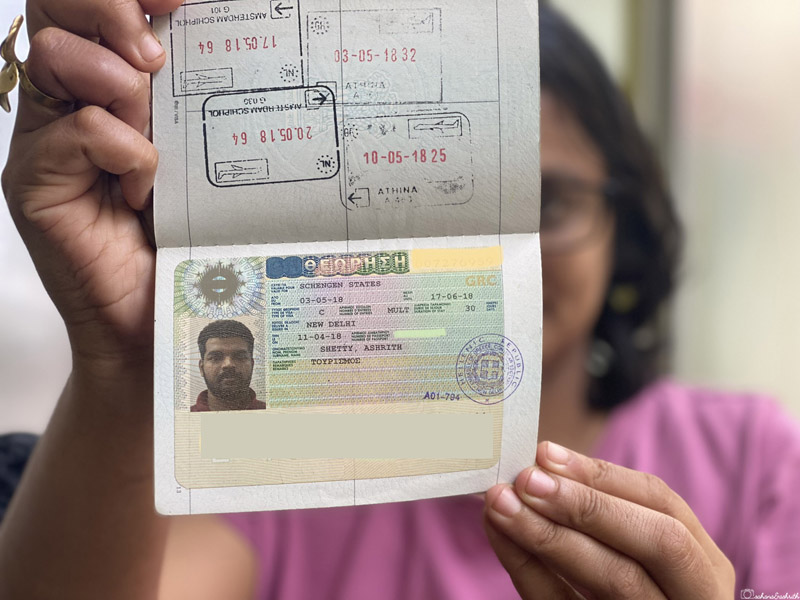
But, you’ll need to be patient and pay attention to all the details when gathering your documents and applying well in advance.
If you’re a full-time employee with limited time, handling the whole process can feel like a lot.
While we managed to get our Greece visa on our own, for the second Schengen visa, I decided to go with i-Visa.They’re super helpful and really simplify the whole process – almost like a one-click solution.
How long in advance can you apply for a Schengen visa?
While you can apply up to 6 months before your travel date, I personally prefer applying and booking an appointment 2 to 3 months in advance.
How long will a Schengen visa be valid
As per official sources, a short-term Schengen visa, AKA tourist visa (Type C), is valid for maximum 90 days within a 180-day period.
This means you can stay in Schengen countries for up to 90 days in total within a rolling 180-day window.
But here’s the catch—you won’t always get a 90-day visa within 180 days. The validity and allowed duration of stay depend on the Schengen country you’ve applied to and your itinerary.
How does it work?
For example, during my 2018 Greece trip with my husband across dreamy Santorini and a small town Meteora where monasteries float in the sky , we planned and applied for the visa with a 24-day itinerary.
But I was issued a visa valid for 30 days valid for 45 day period.
In 2022, I applied for a 21-day visa for Austria+ Germany trip at Austrian embassy but was only given 21 days to stay over 35 days!

I assumed I’d get a 30-day visa for a 21-day trip like I got previously!
In 2025 November, I needed a month visa to visit Portugal for 24 days and the rest in Spain – I was exactly got just a month visa, not for extra days!
So, when applying for a Schengen visa, be cautious and add a few extra days to your itinerary, even if your actual plan is shorter. This gives you more flexibility and avoids last-minute surprises.
Always double-check the details on your visa sticker to plan your travel dates accordingly.
Which Schengen country’s embassy should you apply to?
When deciding which country’s embassy to apply to, consider these three scenarios:
Single-Entry vs Multiple-Entry Schengen Visa
A single-entry visa lets you enter the Schengen Area once. Once you leave, even if it’s before your visa expires, you can’t re-enter. This is great if your itinerary is straightforward and you plan to visit only Schengen countries.

A multiple-entry visa, on the other hand, allows you to enter and leave the Schengen Area as many times as you like, as long as the visa is valid. This is perfect if your trip includes non-Schengen countries (like the UK or Turkey) or if you travel to Europe frequently.
For example, with a single-entry visa, you can visit France, Italy, and Spain in one trip. But if you want to leave for Turkey and return to Greece, you’ll need a multiple-entry visa.
Explaining the scenarios with personal example
Back in 2022, I travelled to Greece, Turkey, the Netherlands and Belgium for 24 days.

Since I spent most of my time in Greece—10 days to be exact—I applied for my multiple-entry Schengen tourist visa through the Greek embassy. Neither the Netherlands or Belgium. And Turkey is not in Schengen area.
Similarly, when I planned my trip to Austria and Germany, I arranged to stay two weeks in Austria and five days in Germany. – I never exited Schengen area.
So, I got my single entry Schengen tourist visa from the Austrian embassy.
Steps in getting Schengen tourist Visa on an Indian passport.
Where should I land first?
Now, according to the official Schengen rules, you can land in any Schengen country with a valid visa.
But here’s a pro tip: it’s always best to first enter the country you got your Schengen tourist visa from.
That’s why I landed in Greece, Athens to be specific first during my trip.

In 2022 trip, I arrived at Austria first when visiting Austria and Germany.
On my Portugal and Spain trip in 2025, I got my Schengen tourist visa from Portugal ( easier to get appointment than Spain+faster). So I landed in Portugal’s Lisbon first.
It keeps things simple and avoids unnecessary questions at immigration!
Check the Visa Outsourcing Agency
In India, embassies don’t handle Schengen visas directly. Instead, visa application centres like VFS Global or BLS take care of submissions, biometrics, and paperwork.
These aren’t travel agents, kind of official partners of embassy. They collect, check and pass your documents to the embassy, which makes the final decision.
Different countries use different centres (e.g., Greece uses GVCW, Spain uses BLS), so check which one applies to your destination!

Gather Required Documents
Whether it’s VFS, BLS, or GVCW they all have a fixed list of mandatory documents for Indian tourists. These typically include:
- Valid national passport ( min. 6 months validity)
- Two passport-sized photographs (white background, recent, particular size mentioned by the embassy).
- Completed visa application form (signed by the applicant).
- Personal covering letter
- Travel plan
- Flight reservation (with names of all travellers).
- Proof of accommodation (hotel bookings, package tour confirmations).
- Travel insurance (minimum coverage as prescribed by the embassy).
- Proof of financial status – varies for employed, self employed, retired and unemployed
- Introduction letter from employer or business (if applicable).
- Visa fee ( varies yearly, roughly below 100 euro for adults)
Schengen visa requirements for Indians : Documents needed
Passport
Make sure your passport isn’t expiring within 6 months of your travel date and has enough empty pages (usually 2 to 4). If it’s close to expiring or running out of pages, apply for a new one as soon as possible.

Photos
Schengen countries typically require passport-sized photos with a white background, 35mm x 45mm, and no smiling.
You don’t need to look grumpy like I do in mine, but avoid fancy poses or converting selfies into photos.
Tip: If you’ve got a thick beard in the photo, keep it for your trip. Some people had issues at immigration after shaving post-photo.
Visa Application
Download the application form from the official website. Filling it out can be nerve-wracking, but stay patient! Double-check spellings and all details.
- GVCW: Link to application and document checklist for Greece visa
- VFS Global: Link to Official website for applications & documents
- BLS: Link to application & document checklist for Spain visa

You’ll need info like your first country of arrival, accommodation details (address and phone number).
Don’t forget to sign where required—there’s more than one spot!
Covering letter with travel plan
Address your covering letter to the visa officer at the embassy of the country you’re applying to. In India, it’s usually New Delhi, but verify if it’s another city.
Start with your full name (as in your passport) and passport number.
Include your exact stay duration and travel dates in day-month-year format (e.g., 23 Aug 2025).
List the documents you’re submitting and mention if you’re travelling alone or with family/spouse. Add their full name and passport numbers too.
Clearly state your purpose—tourism—while keeping it personal yet professional.
Here are some ideas to personalise it:
- Austria: Share your excitement about trying Austrian alpine hikes like I did.
- Spain: Mention your interest in Spain’s beautiful architecture.
- Portugal : Tell how you love to explore Portuguese desserts and spend time at their beaches – I did it and worked
- Italy: Talk about your love for Italian food and wine culture.
Travel plan
If you’re going on an organised tour, they’ll usually provide all accommodation details and a day-to-day itinerary.
Just make sure your name (as in your passport), travel dates, passport number, and payment receipt are included.
If you’re travelling independently like me, which I highly recommend for better exploration, you’ll need to create your own itinerary.
When presenting your day-to-day itinerary, make sure it sounds realistic. If you’re applying for a 15-day Italy visa, don’t say you’re spending all 15 days in Rome. Instead, spread it out across different cities, like most travellers would.
Use Excel or Google Sheets to keep it simple and organised.
While the Schengen website doesn’t specify this format, I’ve seen applications rejected due to unclear itineraries. So, it’s better to be safe!
Include columns for:
Remember, your itinerary isn’t set in stone. Once you get your visa, you can make changes, as long as you don’t exceed the allowed duration of stay.
For example, I only listed Vienna, Salzburg, and mountainous town Innsbruck in my travel plan doc submitted for visa purpose.
But visited Austria’s wine valley by river Danube side Wachau and Tirol’s alpine town Kirchberg too.

Air tickets
You need confirmed air tickets for a Schengen visa, but if your visa gets rejected, you’ll lose the money- Flights are often the biggest chunk of your travel expenses. So book paid yet refundable tickets on airlines websites directly.

Make sure your name and travel dates are spelled correctly—one small mistake can lead to rejection. If a travel agent books it, double-check everything yourself.
Accommodation booking

Some embassies insist on a fully paid accommodation booking for visa applications—you’ll find plenty of people talking about it online!
But, it is risky – if your visa gets rejected, all the money goes for toss with non-refundable fully paid bookings.
If you’re using third-party platforms like Booking.com, make sure the hotels you book are fully payable but can be cancelled later with only a small fee deducted.
Or, a trusted local agent can sort a confirmed booking and refund it later (for a small fee). Better than losing all your money!
Ensure all guests’ details are included in the booking—this is a common mistake. For example, in our Austria bookings, I listed both my name and my mum’s.
If four of you are travelling together, all names must be included in the accommodation booking.
When printing, make sure the page includes the full address and contact details of the accommodation.
You don’t have to stick to the same hotels once your visa is approved, but for the application, you need confirmed accommodation for every night of your stay.
Travel Insurance
Schengen countries has specific travel insurance coverage requirements, and not all insurance companies are accepted.
Check the approved list of providers to ensure your policy is valid.
Also, make sure the policy covers the right age group, especially if you’re travelling with kids or senior family members.
Proof of funds
According to the official website, you need to submit 6 months of bank statements showing enough balance (at least 50 euros per day per person), ITRs for the past 2 years, and 3 months of salary slips to prove you can cover your Europe trip expenses.

But honestly, this is just the bare minimum.
Even if you provide these, there are a few things to keep in mind, especially with your bank statement.
Bank Statement Tips
When submitting your bank statement as proof of funds, remember:
Proof of funds for unemployed and students
For students, retirees, or unemployed applicants, a sponsor can cover the trip expense. so sponsorship letter is necessary along with proof of funds.
The sponsor should ideally be an immediate family member—spouse, sibling, or parent.

The sponsorship letter should be written by the sponsor and addressed to the visa officer at the embassy.
The sponsorship letter should include:
If the sponsor is your spouse, make sure to attach your marriage certificate.
If your parents are sponsoring the trip, their names will already be mentioned on your passport, which makes things simpler.
Financial proof of self employed / Freelancer
If you’re a freelancer or self-employed, focus on submitting 6 months of bank statements and ITRs (personal or company-related, credit card statement, as long as the company belongs to you).
Make sure to include your business registration certificate with both your name and the company name clearly mentioned.
Also, ensure your account has enough funds and shows consistent transactions—this is key to proving financial stability.
For Retired folks
If you or your retired parents are travelling to Europe, include their pension statements and property ownership documents.
If pension statements or property documents aren’t available, submit the same documents as unemployed applicants, like a sponsorship letter and proof of funds.
For example, when my father-in-law travelled to Europe, we submitted his house ownership documents along with a sponsorship letter as part of the application.
Introduction letter from employer
If you’re a salaried employee like me and my husband, Ashrith, you’ll need an Introduction Letter, also called a No Objection Letter or Leave Approval Letter.
It must:
- Be on the company’s letterhead, with the name and address of company clearly mentioned.
- Confirm your employment duration and approval of leave for the specified travel dates.
Most corporate employers now provide automated, digitally signed letters addressed “To Whom It May Concern.” Honestly, that’s usually enough.
We never had it addressed to the embassy, and it worked perfectly to get our Schengen visa.
Getting Schengen visa for honeymoon with Indian passport
You can definitely get a Schengen visa with your Indian passport for your honeymoon.

The list of documents and the process remain the same, but there are a few extra documents you’ll need to include for honeymoon travellers.
In 2018, our first Europe trip was our honeymoon. We got our Schengen visa from the Greece embassy, as it was our first destination during our 24-day trip across Greece, Turkey, the Netherlands, and Belgium.
Extra documents for unmarried couples applying for Schengen short stay visa for Honeymoon.
Alongside standard requirements like Individual cover letter where you mention that you will be getting married on xyz date, add name of your spouse, passport number, financial proofs and passports as an Indian honeymooner, include the following extra documents.
Not mentioned in official list, but you must add this – trust me, it did give our application a boost.
This might sound like a lot, but trust me, we submitted all of this, and that’s why our visa was accepted.
I’ve also heard of couples where one person’s application was rejected while the other’s was accepted, simply due to anomalies in the documents.

Submitting documents at application centre
Arrive at the visa application centre 10 minutes early. You’ll be called in batches based on the time slot you selected when booking your appointment.
Popular ones like the Netherlands, France, and Switzerland (where most Indian tourists apply) usually have multiple desks to manage the crowd.
The staff at your assigned desk will check all your documents and take your biometrics. If something doesn’t meet the requirements—like your photos, a missing photocopy, or a small correction in a document—they’ll let you know right there.
Minor issues like missing photocopies or incorrect photos can be fixed on-site, as centres usually have photocopy and photo services.
Sometimes, it’s something simple, like needing an extra passport copy or re-writing your cover letter.
Don’t worry —application centres often have photocopy services and photo studios in case you need something last minute
But here’s the thing—if you’re missing an important document that takes time to arrange, they’ll send you back. Your application won’t be processed, and you’ll need to book another appointment, pay the fee again, and come back.
If everything looks good, you’ll pay the visa fees at the end, either by card or cash (UPI usually isn’t available).

Do they take an interview for a Schengen visa in India?
You may be called for an interview after submitting documents and biometrics, though it’s not guaranteed. If required, it’ll usually take place at the visa centre, not the embassy.
For example, in 2018, we applied for our Greece visa in Bangalore and were set for an interview, but it got waived after we arrived at the venue!
For Austria + Germany in 2022, no interview at all—we got the visas with just detailed documents at VFS. They never called for an interview. So, expect the unexpected!

How to get processed application and passport back?
You’ve got two ways to get your processed passport back:
- Courier to your address: For an extra fee, it’s sent to your home—no need to match the address on your passport. This is what I always do; so much easier!
- Pick it up at the application centre: If you prefer, you can collect it yourself.
Whether your visa is approved or not is up to the embassy. The application centre only checks your documents and forwards them. Once it’s done, your passport is sent back.
So, you won’t know if your Europe trip is happening until you get your passport and see that visa sticker!
How long does it usually take to get a Schengen visa in India?
As a rule, the processing time for a Schengen visa application shouldn’t exceed 15 calendar days from when the embassy receives it.
If your checklist is incomplete, your application will be on hold until all the required documents are submitted.
For reference, my Greece visa was processed in 15 days, and my Austria visa took just 10 days.
Other advantages of having Schengen visa on your passport
A Schengen visa really gives your Indian passport a boost! With a valid Schengen visa on your Indian passport, you can apply for e-visas (electronic visa which you can apply online) or get visas on arrival in many countries that usually require more paperwork.
For example, with my Greece Schengen visa, I got my Turkey visa online in 5 minutes. Without it, I’d have faced a much longer process.

Passports from countries like India or the Philippines (You can check the Henley Index to see how strong your passport is) need tourist visas for most destinations. But Schengen permit makes it a lot easier to travel for weaker passports.
FAQ
How much bank balance is required for Greece tourist visa?
It depends on your number of your stay in Greece. The consulate specifies a minimum of 50 Euros/day. So if you are in Greece for 6 days, you must have money equivalent to 300€ along with the proof of paid accommodation, flight and other travels.
Can I apply for Schengen visa from any city in India?
Yes, you can apply for a Schengen visa from anywhere in India at the nearest visa application centre, such as VFS Global (for most European countries), BLS (Spain), or GVCW (Greece)
Why Schengen visa is rejected for Indians?
One of the main reasons Indian Schengen tourist visas get rejected is inaccurate financial documents. This includes things like submitting an inactive bank account with sudden large deposits or insufficient funds.
Which country is difficult to get Schengen visa?
According to researchers, Malta is considered the toughest country to get a Schengen visa.
Found our guide useful for getting a Schengen short stay visa on your Indian passport? Let us know in the comments below!


